
February 2026 Armchair Notes
Two Books on Creativity, Dostoevsky, Thomistic Romance & Notebooks

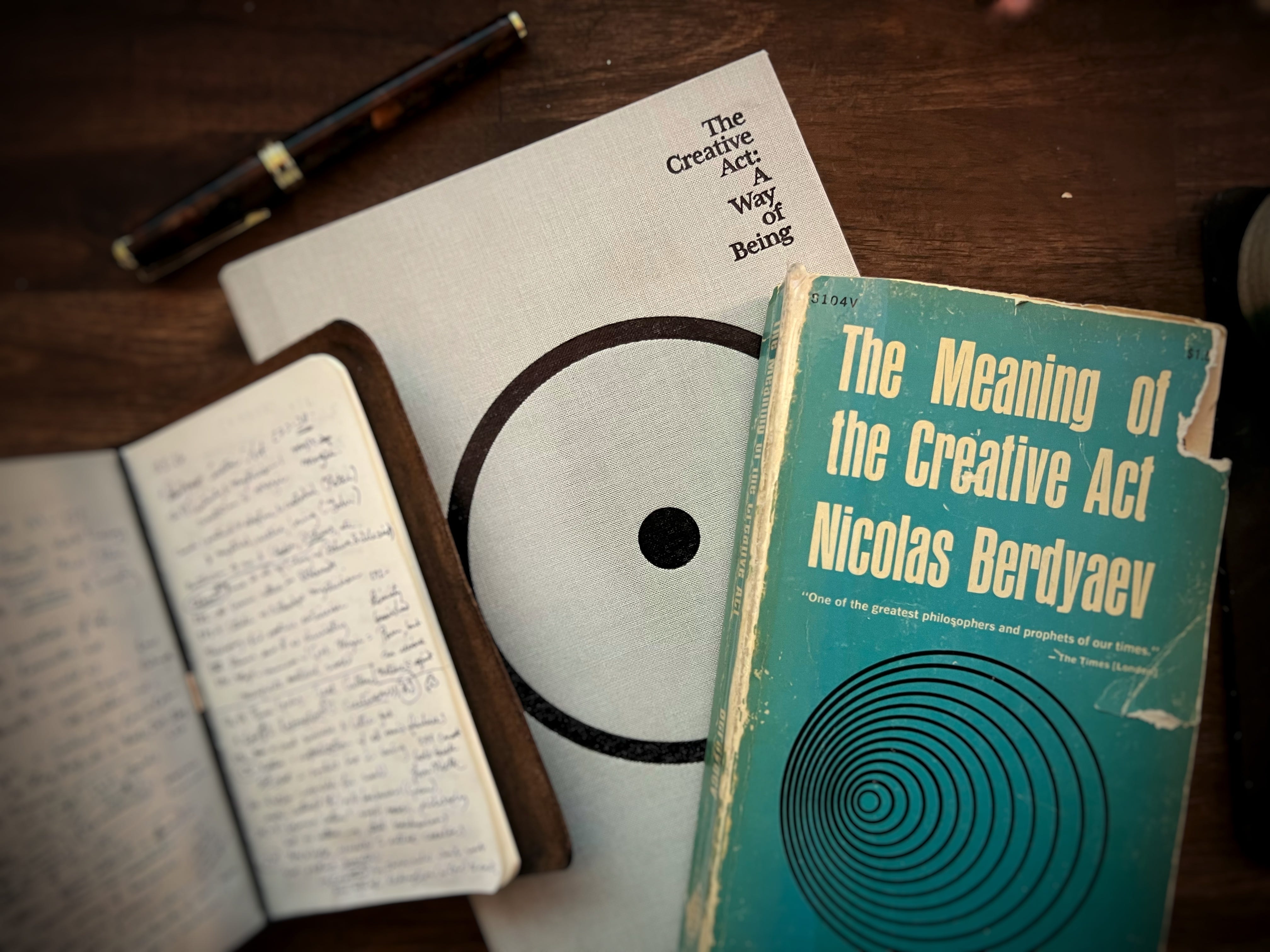
My entire life I’ve been concerned with questions of creativity. I began as an artist, then I moved into music and writing, and now my day job involves the creative work of frontend software development. Even my masters thesis was about beauty and creativity in theology. Along the way I’ve amassed a collection of books about creativity, aesthetic philosophy, art, music, and various crafts. Last month I decided to tackle that whole shelf over the coming months, so you’ll see more reviews dealing with the philosophy of creativity and the nature of art in these reviews. Last month I reviewed Art & Fear by Bayles and Orland, and this month I have two books which deal with “the creative act” itself. Cheers to you and your creativity!
Reading
The Creative Act: A Way of Being by Rick Rubin
The two core principles of Rick Rubin’s creative philosophy are Openness and Iteration.
Openness lends Rubin’s philosophy its spiritual character. He encourages artists to cultivate an openness to grace rather than trying to assemble songs or images through sheer effort: “The whisper cannot be wrestled into existence.” Artists must open themselves up to receiving their creative ideas “from Source” which lies both beyond and within them; we open ourselves up to the world or to the God outside of us, just as we open ourselves up to that which lies within us.
This openness paradoxically relies upon boundaries, since the creative act happens within a narrow window of time and attention. If we stretch that moment out too long, the creative energy dissipates. What shook me early on in the book was when he mentioned that ideas come to us when it’s their time—like a cloud swollen with rain or a radio wave sent out for any antenna to pick up—and if you don’t do something with it, someone else will. There have been many a time since starting this blog when I had an idea strike me, but I held it too long, only to see a wave of posts come through my feed dealing with the same theme. It’s not that that they were more open than I was, but they were more open to doing something with the idea.
This leads us to the second principle I took from Rubin: Iteration. This idea recurs so often that the book itself can be seen as many iterations on the idea of iteration. “The goal of this piece is to make the next one,” “A full, imperfect draft is generally more helpful than a seemingly perfect fragment,” etc. Just as we must be open to the creative ideas that suffuse the very air we breathe, we must be open to letting those ideas express themselves and alter the direction of our creative endeavors. Iteration is the natural extension of openness: not only openness to ideas or subject matter, but openness about our process and methods. Our art provides a record of this openness.
A work of art is not an end point in itself.
It’s a station on a journey.
A chapter in our lives.
We acknowledge these transitions
by documenting each of them.
The Meaning of the Creative Act, by Nicholai Berdyaev
Holy shit. Berdyaev is a wild ride. While Rubin reads like a gentle breeze on a quiet pond, Berdyaev barges like the rush of a river or the thunder of a storm. His core principle is that creativity is rooted in freedom, and that freedom comes from another world. True freedom does not come from this world, as everything here is determined and governed by “natural” laws that restrict our freedom, our originality, our genius, and our art. Most of us find ourselves as lowly humans, adapting ourselves to the necessities of “this world.” But in moments of creativity we seem to transcend this necessary limits and bring something manifest something new from “another world.” Thus, the goal of creativity is to manifest so much of the other world that this world—with all its limits, its lies, its sufferings, its death—vanishes away.
Unfortunately, most of what passes for art, religion, society, and even love perpetuates the process of adaptation to this world rather than the creation a new one. Berdyaev views the world through three phases or epochs: law, redemption, and creativeness. Many of us are not ready to be creative, because we are still concerned with the phases of law and redemption. Both of these phases are concerned with putting us back in accord with things as they have always been; law reminds us that we have strayed from what is acceptable; redemption restores us to an acceptable state. Both reinforce a status quo and adapt us to the world of necessity: we become acceptable citizens, acceptable spouses and parents, acceptable members of acceptable religions, and makers of acceptable art. But being acceptable and being creative are not the same.
In fact, being creative and manifesting “another world” will often seem unacceptable to people who are concerned with preserve the order of “this world.” Thus, Berdyaev scatters many scandals through the book: Nietzsche’s Zarathustra has more to teach us about Christology and anthropology than most of the dusty hermits holed up in the desert; philosophy is not a science and shouldn’t care about providing proof for its ideas; rather than becoming fully masculine or fully feminine, love is about becoming androgenic; since most people use children to reinforce their identities, the institution of marriage should be transcended; Christian art should be more romantic than classical; while necessity demands everything become democratic and egalitarian, creativity is always hierarchical and aristocratic.
While this is not a book for everyone, it does offers many significant insights as well as admirable challenges. He integrates insights from Boehme, Nietzsche, Dostoevsky, and many more eclectic sources. His emphasis on freedom and personhood gets picked up in the work of many modern Orthodox theologians, such as Met. John Zizoulas. Likewise, I set Berdyaev’s Creative Act in a constellation with Florensky’s Pillar & Ground of Truth and Bulgakov’s Philosophy of Economy (reviewed here and here, respectively). All three of these books form a trinity, concerned with the human desire to freely create and manifest something eternal and beautiful in a world that seems so tragic, ruthless, and dead. This message seems more prophetic to me, day after day.
Man must free himself from the lower ranks of the hierarchy of nature, must become ashamed of the fact that he is slavishly dependent upon that which is lower than himself and which should rightly depend upon him. Nature must be humanized, liberated, made alive and inspired by man. Only man can take the spell off of nature and give it life, since it was man who bound nature and condemned it to death. Man’s fate depends upon the fate of nature and of the cosmos, and he cannot separate himself from this. Man must give back spirit to the stones, reveal the living nature of stones, in order to free himself from their stony, oppressive power. There is a heavy layer of dead stone in man, and there is no other way of escaping from it than by liberating the stone itself.
Writing
In terms of writing, I’m continuing to put out essays and lead video discussions for our Brothers Karamazov Book Club. This month, we had a bit of a health scare in my family, but thankfully everyone is healthy and life is back to normal. Since then the companion essay for Book Four “Strains” is already published, and the two essays covering Ivan’s “Grand Inquisitor” and Zosima’s life and teachings will be posted in the coming days. Until then, feel free to watch the recording from our live discussion where I covered all of Part II:


In addition to Dostoevsky, I published two other essays on topics very close to my heart. First, a Valentine’s essay that shares the best insight about love I’ve ever learned, which came from Thomas Aquinas. Then I did a round up of my “journaling ecosystem,” outlining the different kind of notebooks and different journaling techniques I’ve been using over the last year—as well as some new ones I’m trying.


Well, that’s all for me. How about you? What have you been reading and writing in February?
Our next live discussion on Monday, March 9th at 8pm EST where we’ll dive into all of The Brothers Karamazov Part III together. Then on Saturday March 28th at 11am EST, we have our monthly members Zoom call where we chat face-to-face a bit.
Get caught up on last month:

Great article. I especially appreciate your analysis of Berdyaev.