
April 2025: Armchair Notes
Many books about Beauty and Time—Florensky, Proust, Wilde, Eliot, and God.

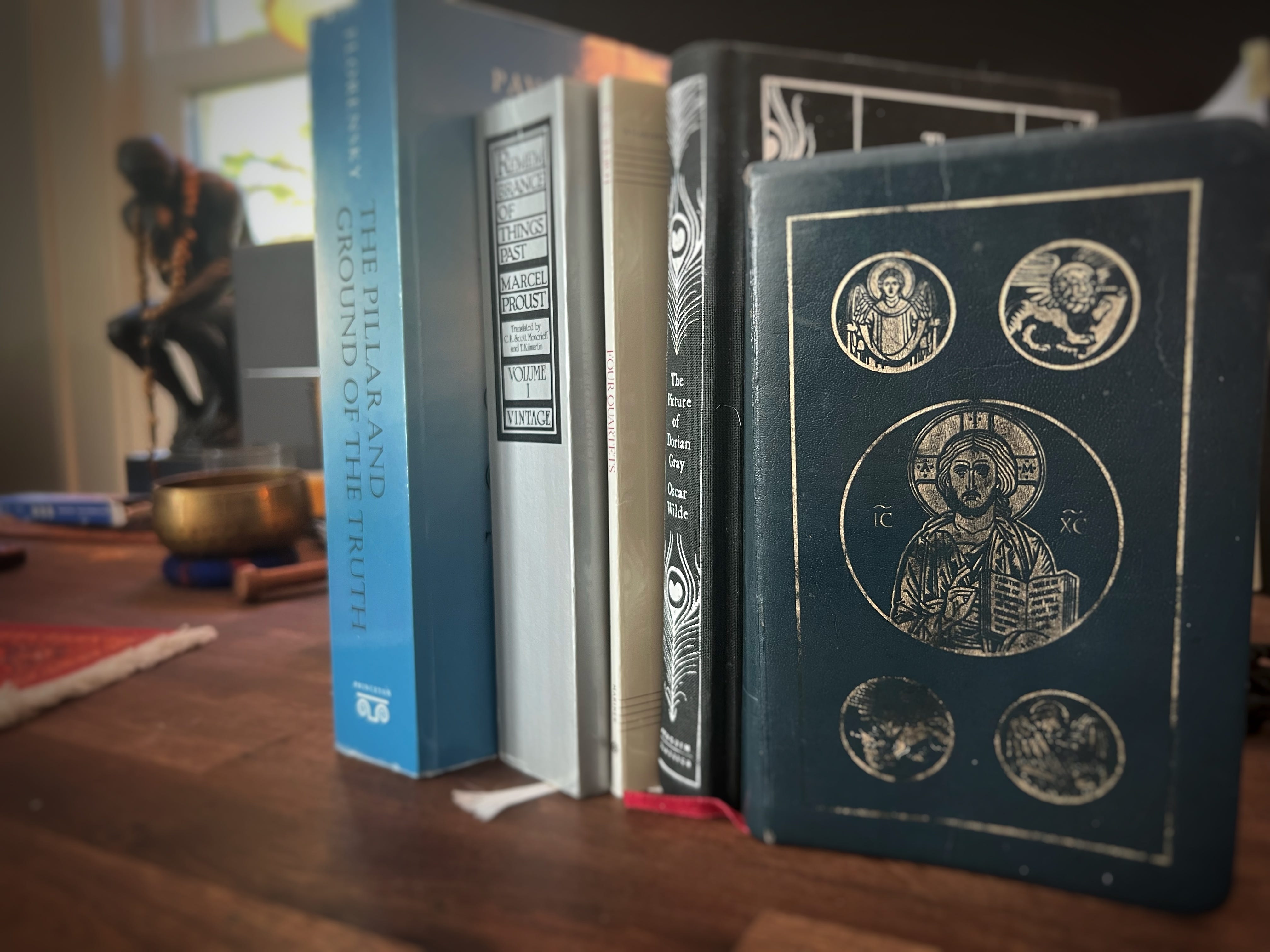
In being true to the name of this blog, here are a few notes about books I’ve finished this month. Along with a few initial impressions of my own, I’ve also included a quote to whet your appetite. In the comments below, let me know:
What did you read last month? What are you looking forward to reading this month?
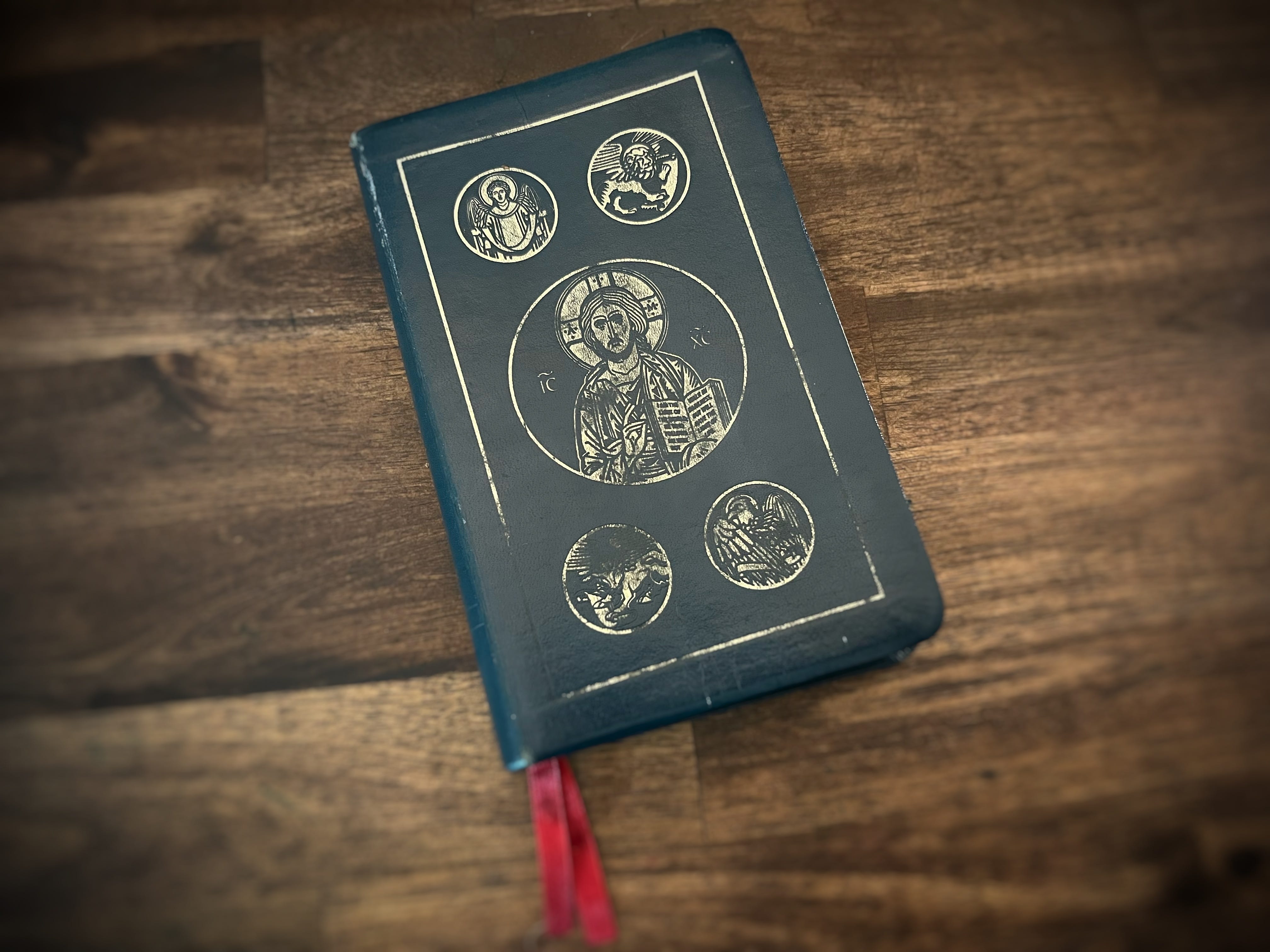
I can’t understand how I was ever declared a “Master of Theology,” when I never even read the whole book. Don’t get me wrong, I read huge swaths of the Bible. I had a Pentateuch class, a Prophets class, a Gospels class, and even a few intensive seminars of Wisdom literature and Johannine literature. I even wrote instructors manuals on New Testament Greek. Despite all that, a few books remained unread.
This year, I decided to change that. I’m reading the whole Bible cover-to-cover-ish. My reading plan runs in this order: Gospels, Letters, Psalter, then rest of the Old Testament. Now, I’ve finished the New Testament, and I’m taking my time going through the Psalms. Several things struck me on this first leg of my continuous read.
When it comes to the Gospels, it can initially seem like a slog to read the “same story” four times in a row. But it highlights the differences between the Evangelists so much better; when read together, their unique voices and perspectives become more identifiable.
Before now, I’ve never felt drawn to read the Apocalypse of John. Frankly, I always assumed it only existed for Protestants to cook up quirky theories of the End Times. How many people get into heaven? What are the signs to look for in our own age? Instead, I opted to be blissfully ignorant—I didn’t want to see how the sausage was made. But I was surprised by how much I enjoyed it. It’s an fantastic voyage that reminded me of the flourishes of De Quincey or Huxley at times. Rather than getting hung up on how it’s all going to end, I was impressed by how he will “make all things new” (21:5).
The last time I read a lot of the Bible, I was a student. Now, as a husband and a father I read many of the Letters different. This time around, I loved the more “boring” letters, like 1 Thessalonians, Titus & the Timothies. The practical advice about how everyone in the community can grow up and be more mature really hit home for me in this season of life. We don’t need to be right. We need to take care of each other.
On that note, while I’ve always known that James wrote a practical book, I forgot just how poetic he is. The tossing waves of the double-minded man, the grass withering and the flower falling as our beauty and riches succumb to the ephemeral flow of time—and of course his classic description of our untamable and fiery tongues:
The tongue is a fire. The tongue is an unrighteous world among our members, staining the whole body, setting on fire the cycle of nature, and set on fire by hell. For every kind of beast and bird, of reptile and sea creature, can be tamed and has been tamed by humankind, but no human being can tame the tongue—a restless evil, full of deadly poison. With it we bless the Lord and Father, and with it we curse men, who are made in the likeness of God. From the same mouth come blessing and cursing. My brethren, this ought not to be so. Does a spring pour forth from the same opening fresh water and brackish? Can a fig tree, my brethren, yield olives, or a grapevine figs? No more can salt water yield fresh. (3:3-12)
The Pillar and Ground of Truth, by Pavel Florensky
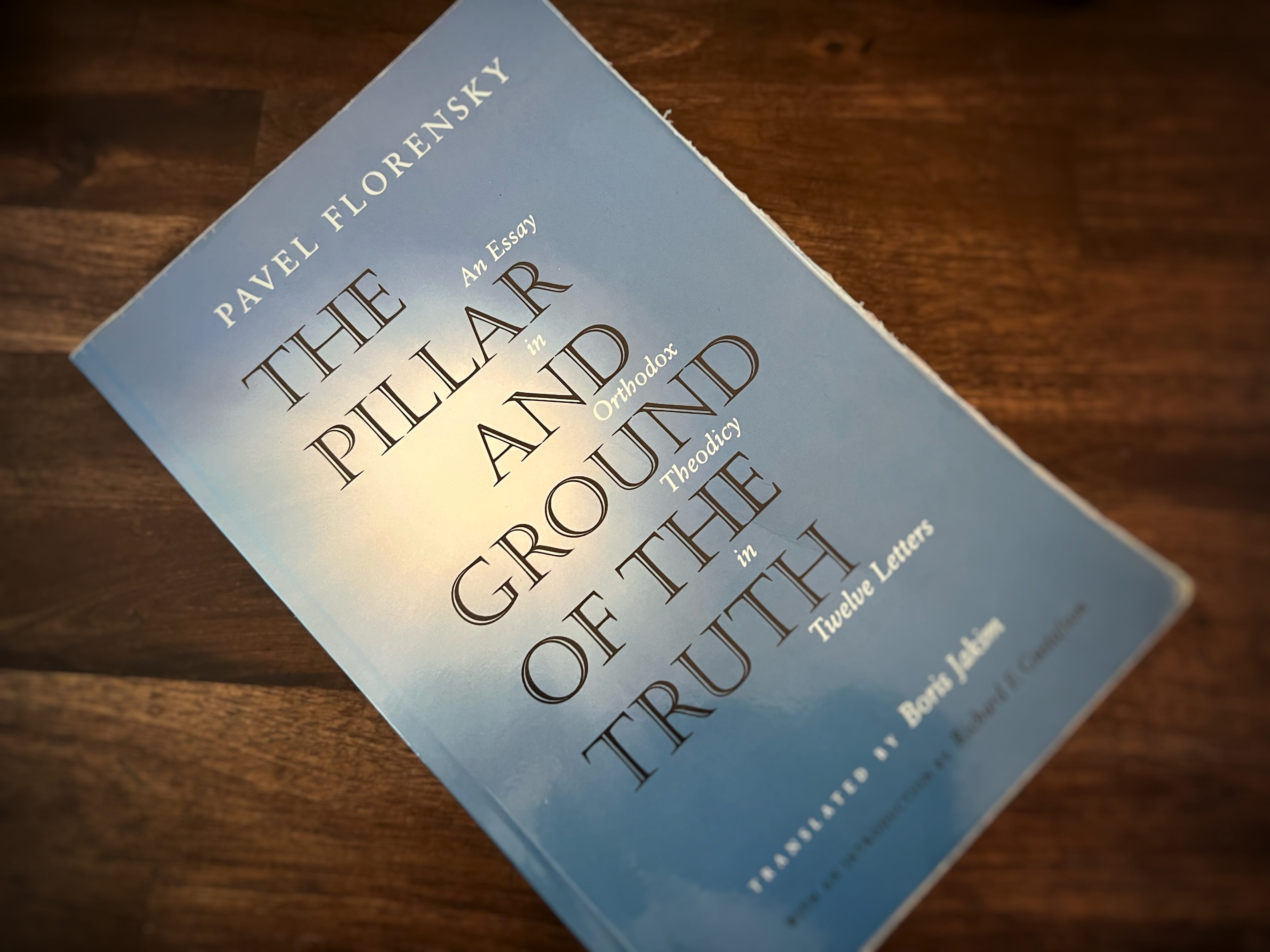
If you ask an Orthodox Christian whether something is this or that, they will reliably say it’s both. Is the Trinity one or three? Both. Is Christ human or divine? Both. Will all be saved or will some be damned? Both. Orthodox theology falls in line with that aphorism from Yogi Berra: “When you come to a fork in the road, take it.”
This aspect of the Orthodox phronema is on full display in Florensky’s series of “letters to a friend” on various theological topics. The spiritual and material world, truth, doubt, the Spirit, sin, damnation, wisdom, friendship—it’s so comprehensive, it reads almost like a Russian Symbolist catechism.
Throughout all these diverse subjects, one thread ties them all together for Florensky: consubstantiality. The I and not-I correlate to one another; the divine and human natures correlate to one another; two friends could not be friends without one another. In the face of irreconcilable antimonies, our normal response is what he calls a “homoiousian” approach of similarity, whose series of compromises really ends in absurdity. Instead, he advocates for the “homoousian” way of love, triunity, beauty, friendship, paradox, and mystery—which all offer a unifying embrace and says, “Both.”
I found his discussion of “Gehenna” a particularly interesting application of the homoousian principle. There’s an objective sense in which we are wholly and universally saved and there’s a subjective sense in which parts of us (which we have called our “selves”) are damned and cut off through their own isolation. Essentially, the real homoousian person in us is saved, but the false homoiousian part of that person cannot be. Again, it’s both.
Florensky was a polymath and the ground he covers in this book is exhaustive. In addition to being a priest, he was also a mathematician and electrical engineer whose brilliance could not be ignored by the Soviets who were forced to tolerate him. Imagine the scandal: a bunch of communist elites, dealing with important government projects, have to consul a priest in his cassock! Extensive etymologies in Slavic, German, Romantic, Semitic, and even more obscure languages are woven throughout the book. Half of it is actually footnotes and appendices which make the letters themselves only look like the tip of the iceberg.
In addition to his abounding insights, Florensky also filled this book with beautiful passages. As a friend of Andrei Bely (whose hypnotic St Petersburg I read this past January), you can see Florensky likewise fall into frequent fits of Symbolist rhapsody. One would expect an author who writes so much about beauty and aesthetics to live out those concepts in his prose. Florensky delivers. In fact, his aesthetics extended to the book itself—drawing his own illustrations and designing his own typeface.
With all that taken together, Florensky is a perpetual inspiration to me.
I am drawn against my will to transcribe this sweet music of peace, quietude, and repose. The sighs of the purified soul glide continuous one after the other like autumn leaves…
In all three directions of memory, the activity of thought expresses Eternity in the language of Time. The act of this expression is memory. The supratemporal subject of knowledge, communing with the supratemporal object, unfolds this communion in Time. That is what memory is.
Four Quartets, by T. S. Eliot
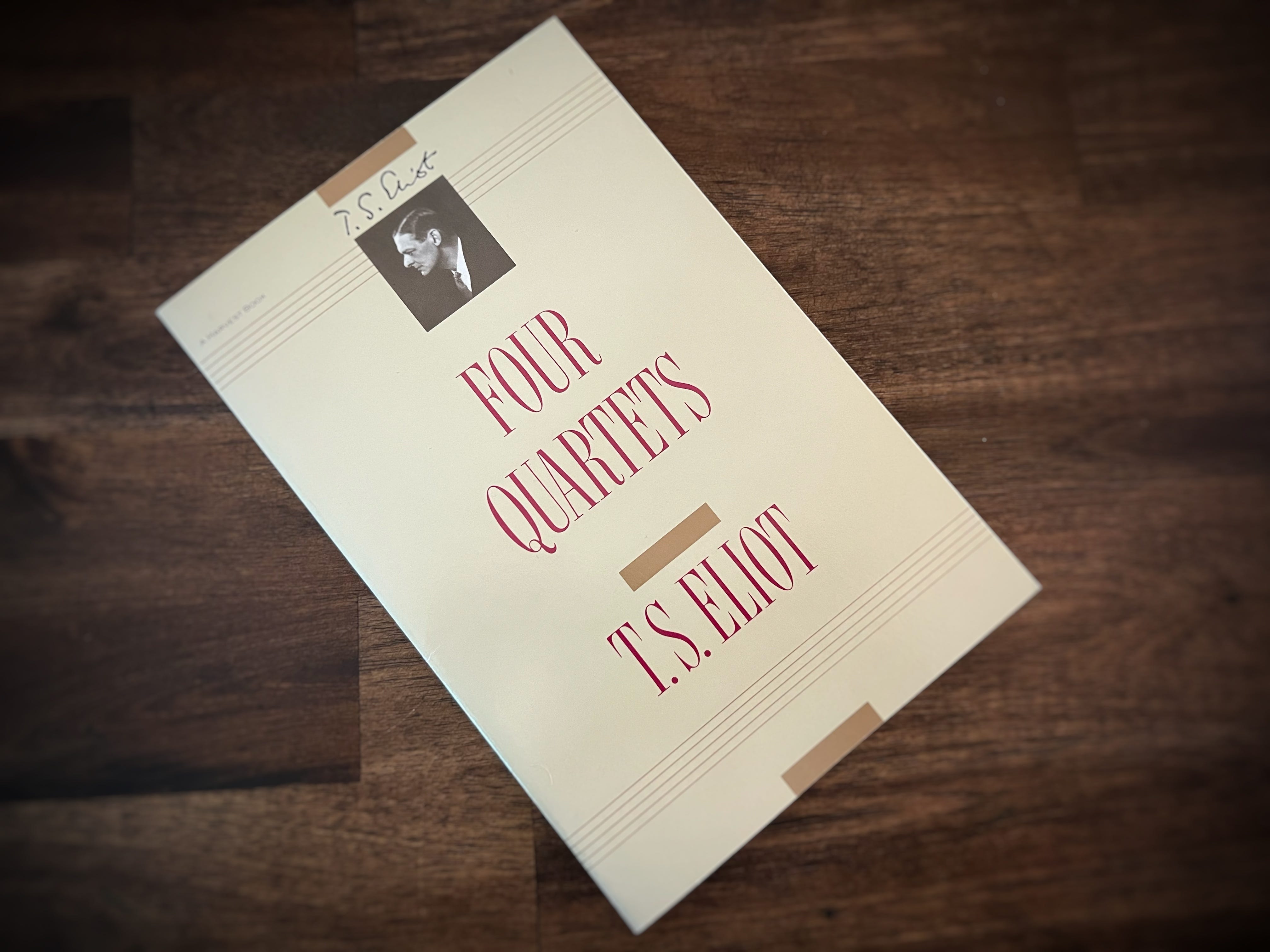
April is poetry month so I had to read at least one book of poetry. These poems have long been favorites of mine. The eternal suspension of moments in “Burnt Norton,” the paradoxes and devotion in “East Cocker,” the elemental power of “Dry Salvages,” and the purgative conclusion with “Little Gidding.” It’s all great, and each deals with one of my favorite themes: Time. Additionally, anyone who opens his work with a quote from Heraclitus is doing something right: The way upward and the way downward is one and the same (ὁδὸς ἄνω κάτω μία καὶ ὡυτή). Eliot’s quartet was a great follow-up to Heraclitus (who I read last month).
Footfalls echo in the memory
Down the passage which we did not take
Towards the door we never opened
Into the rose-garden.
Time present and time past
Are both perhaps present in time future
And time future contained in time past. (I)
What might have been and what has been
Point to one end, which is always present.
Footfalls echo in the memory
Down the passage which we did not take
Towards the door we never opened
Into the rose-garden. My words echo
Thus, in your mind.
But to what purpose
Disturbing the dust on a bowl of rose-leaves
I do not know.— “Burnt Norton”
The Picture of Dorian Gray, by Oscar Wilde
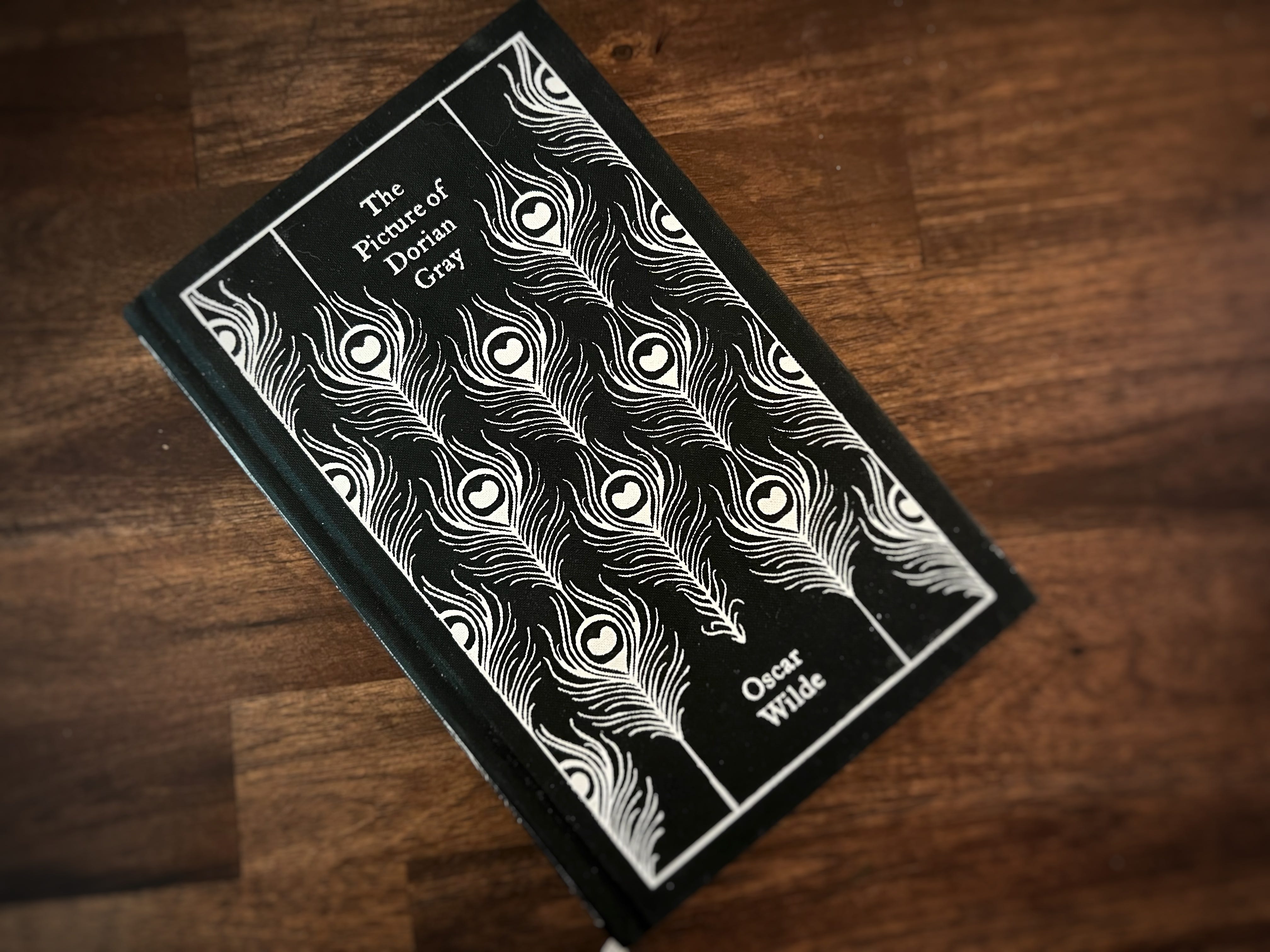
“Oscar Wilde: Rank moralist and didacticist. A favorite between the ages of 8 and 14. Essentially a writer for very young people. Romantic in the large sense.”
Like Nabokov, Oscar Wilde was one of my favorite authors as an adolescent. Unlike Nabokov, Oscar Wilde remains one of my favorite authors today. Ever since I can remember, I look at everything through the questions of art and religion, and I especially love when these questions are explored with eloquence and wit. This all together makes Dorian Gray an abiding microcosm of everything I care about.
Despite charges against this book of “immorality” and “indecency,” I’ve always seen it as a fairly clear Christian parable. An Artist imbues his creation with so much of himself, such that the Piece receives eternal, personal significance. The Subject of the Piece becomes divided between the indelible eternal Image and a deviant Likeness—through the influence of a Lord of Lies, who doesn’t even believe the enticing, impressive, yet utterly vacuous quips he espouses. Finally, we would rather kill our Creator and ourselves rather than be confronted with our shame. When you consider how often the theme of removing sin through confession and inheriting sin through one’s ancestors, it’s practically Augustinian.
Like Basil’s putting himself into the painting of Dorian, Wilde put himself into all of his characters. Typically, “rank moralists” put themselves into one character and props up the rest. Not here. Lord Henry’s witticism sounds like Wilde. Dorian’s Romanticism sounds like Wilde. Basil’s artful and loving attention sounds like Wilde. There’s definitely a moral to the story. And that moral seems to run counter to many of the philosophies this book is known for. But Wilde tells that moral to himself, using all of himself.
There are few of us who have not sometimes wakened before dawn, either after one of those dreamless nights that make us almost enamoured of death, or one of those nights of horror and misshapen joy, when through the chambers of the brain sweep phantoms more terrible than reality itself, and instinct with that vivid life that lurks in all grotesques, and that lends to Gothic art its enduring vitality, this art being, one might fancy, especially the art of those whose minds have been troubled with the malady of reverie. Gradually white fingers creep through the curtains, and they appear to tremble. In black fantastic shapes, dumb shadows crawl into the corners of the room and crouch there. Outside, there is the stirring of birds among the leaves, or the sound of men going forth to their work, or the sigh and sob of the wind coming down from the hills and wandering round the silent house, as though it feared to wake the sleepers and yet must needs call forth sleep from her purple cave. Veil after veil of thin dusky gauze is lifted, and by degrees the forms and colours of things are restored to them, and we watch the dawn remaking the world in its antique pattern. The wan mirrors get back their mimic life. The flameless tapers stand where we had left them, and beside them lies the half-cut book that we had been studying, or the wired flower that we had worn at the ball, or the letter that we had been afraid to read, or that we had read too often. Nothing seems to us changed. Out of the unreal shadows of the night comes back the real life that we had known.
Swann’s Way, Vol 1 of Remembrance of Things Past, by Marcel Proust
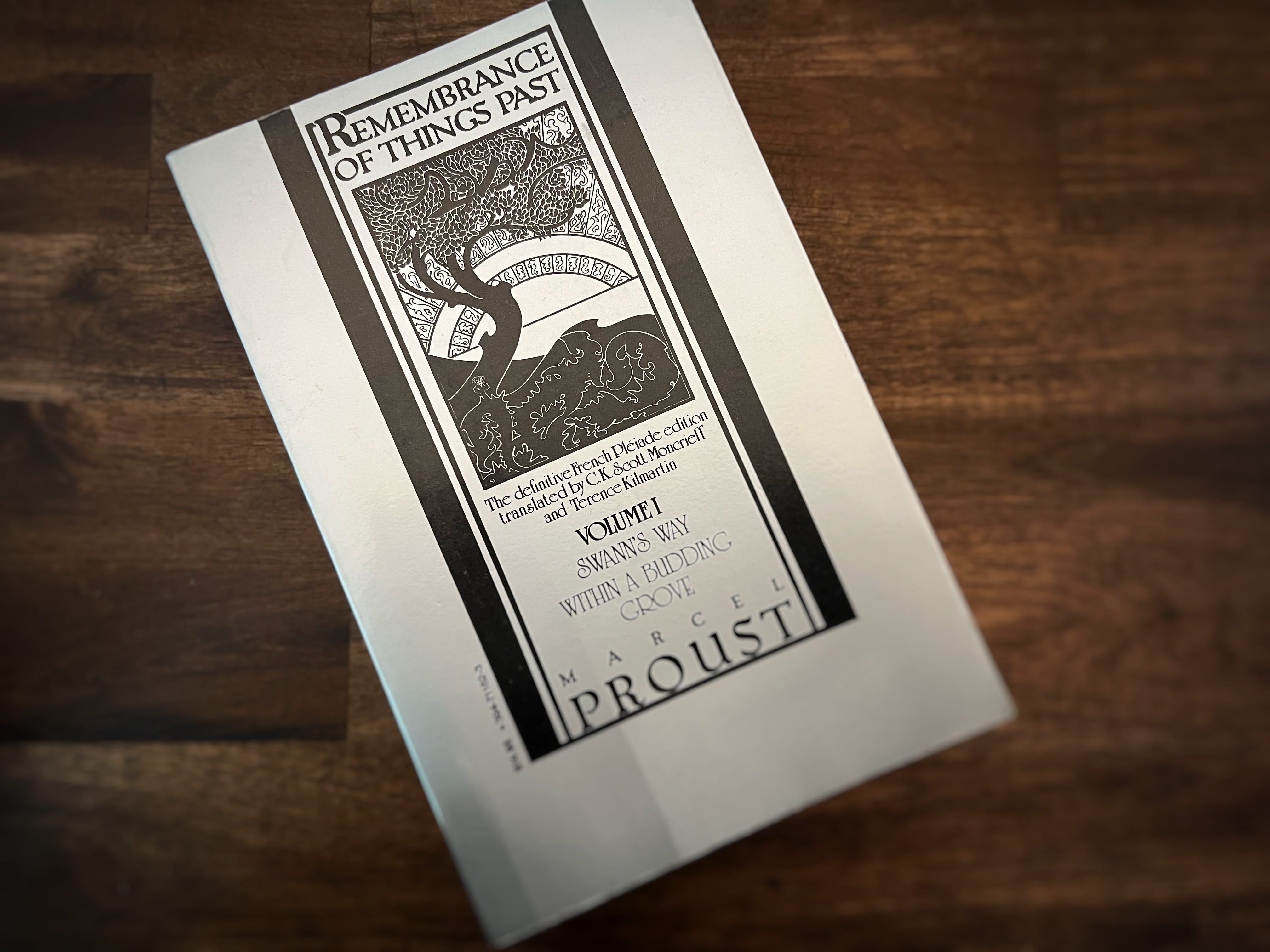
For several years now, I’ve been haunted by Proust. This year he really began to pursue me. Since I love lyrical descriptions in my literature, he’s always been on my radar. Likewise, over the past year, I’ve been working through Nabokov’s four greatest books of 30th Century prose: Joyce, Kafka, Bely & Proust. (Starting Joyce next month) David Bentley Hart often posts about reading Proust. Often I hear Henry Oliver drop passing references about Proust on podcasts. I picked up some Knausgaard, who is, of course, the “Norwegian Proust.” Recently, it all came to a head, when I found myself at the Salvador Dalí museum in Florida, talking on a lobster phone. On the other end was an utterly entertaining AI impersonation of Dalí invited me to pose a question. So I asked, “Who were your favorite authors?” He replied:
Oh the mind dances with delight over those voices dipped in ink! Of the gilded pursues of literature I most enjoy the phantasmagorical visions of Marcel Proust—weaving time’s tapestry in his remembrance.
On the flight home, I started reading the first volume—and it was phenomenal. Proust is everything you think he is: long flowing descriptions of nuances that everyone else overlooked. But what you might not know is that he’s funny. I was surprised by how many comedic moments there were between his observations about sunlight, church architecture, and the emotional effects of hawthorns and lilacs. Everyone talks about Proust’s writing about a madeleine, but not enough people talk about his take on asparagus.
I would stop by the table, where the kitchen-maid had shelled them, to inspect the platoons of peas, drawn up in ranks and numbered, like little green marbles, ready for a game; but what most enraptured me were the asparagus, tinged with ultramarine and pink which shaded off from their heads, finely stippled in mauve and azure, through a series of imperceptible gradations to their white feet—still stained a little by the soil of their garden-bed—with an iridescence that was not of this world. I felt that these celestial hues indicated the presence of exquisite creatures who had been pleased to assume vegetable form and who, through the disguise of their firm, comestible flesh, allowed me to discern in this radiance of earliest dawn, these hinted rainbows, these blue evening shades, that precious quality which I should recognise again when, all night long after a dinner at which I had partaken of them, they played (lyrical and coarse in their jesting as the fairies in Shakespeare's Dream at transforming my chamber pot into a vase of aromatic perfume.
Links
The Pillar and Ground of Truth, by Pavel Florensky
Four Quartets, by T. S. Eliot
The Picture of Dorian Gray, by Oscar Wilde
Swann’s Way, Vol 1 of Remembrance of Things Past, by Marcel Proust
A list of very impressive books - and also inspiring comments! I finished four books, among them a nonfiction book by German political scientist Herfried Münkler on Marx, Wagner, and Nietzsche. And - fitting the times - a collection of essays by Martin Mosebach dealing with catholicism (Der Ultramontane).