
January 2026 Armchair Notes

We’ve been starting off the year strong here at Armchair Notes! Within a few weeks of the New Year, my readership almost doubled, and I’ve been so impressed and enlivened by your response to my work. Thanks especially to all of you who’ve been a part of the Brothers Karamazov Book Club; you’ve brought so much energy and conversation to our reading of this great novel, and I can’t wait to share this next round of companion essays and live discussions with you this month.
So far, in Part I, we have met Dostoevsky’s “nice little family,” saw them run amuck in a monastery, and uncovered the casualties of their passions. If you need a refresher, all the essays and videos can be accessed here. This month, there’s much more to come—with big discussions of the Ivan Monologues (“Rebellion” & “The Grand Inquisitor”) as well as the learning about the life and teachings of Fr Zosima. If ever you’ve been curious about The Brothers Karamazov, February is a great month to join.
Our next Substack Live where I give an intro to Part II will be Feb 9th, at 8pm EST. Our monthly Zoom call for my paid subscribers will be Feb 28th, 11am EST. Both will be scheduled and invites sent out soon. But if you have any questions, feel free to reach out to me. Until then, good strength in your reading!
Reading
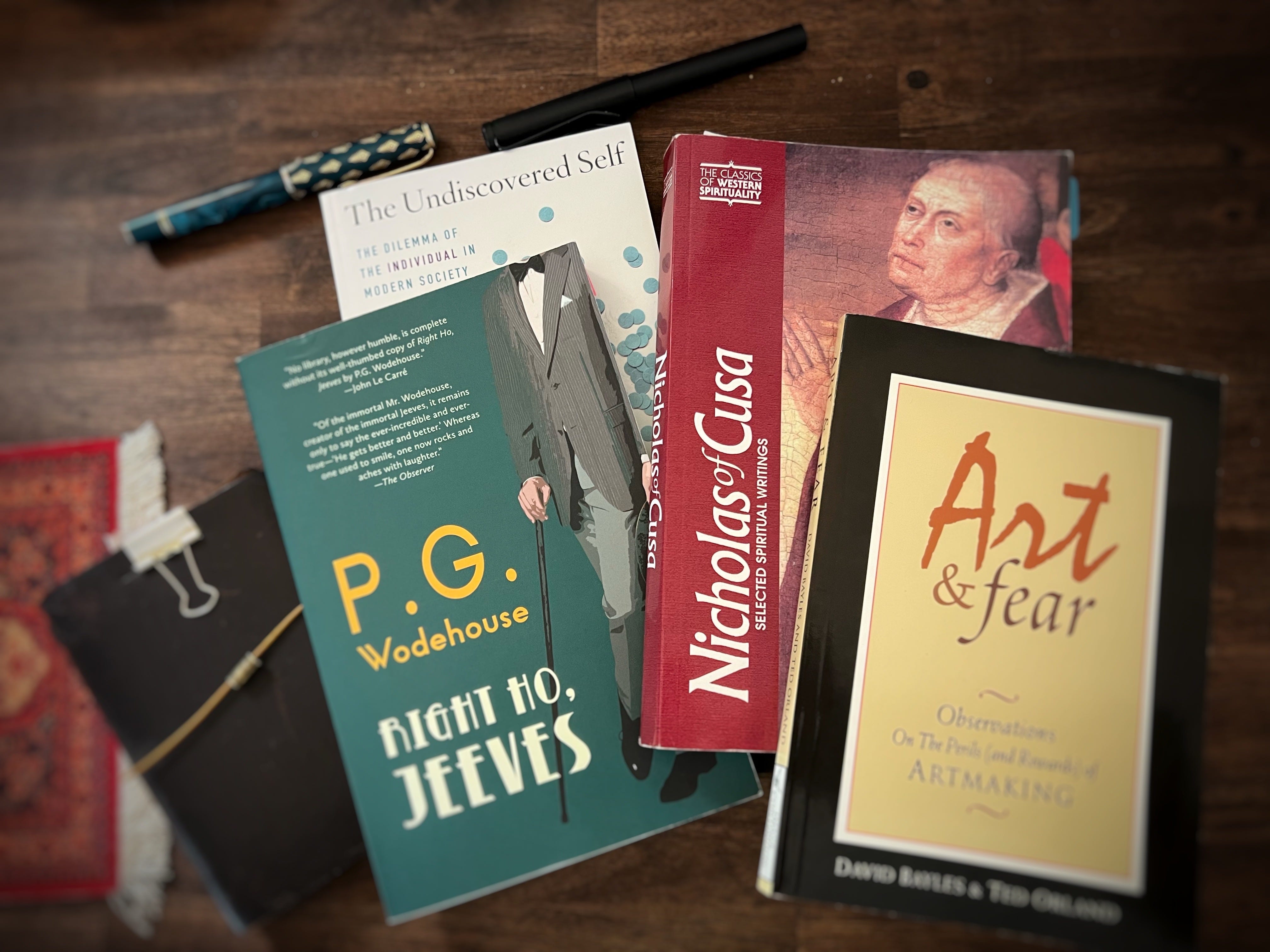
True to the name of the this blog, I like to include a few notes about books I’ve finished every month. Below you’ll get my Montaigne Note, short review, or hot take of the book, as well a quote to whet your appetite, in case you want to dip in to one of these books yourself.
1. Right Ho, Jeeves by P.G. Wodehouse
If you’ve never read any P.G. Wodehouse, you probably take life too seriously. You’ve never been chums with someone named “Bingo Little” or “Gussy Fink-Nottle.” You’ve never substituted a mundane “goodbye” with a “toodle-oo,” a “toodle-pip,” or even a “cheerio.” And I bet you’ve never narrowly evaded an ill-fitted engagement, foisted up on you by a diabolical aunt. I say, what a dashed rummy life you live! Luckily, Sir Pelham Grenville left us dozens of stories filled with such antics, so your life can slap on the ole nosebag and feast on the humor it’s so sorely been missing. This novel offers everything from riotous exchanges at a grammar school to perplexing discourses on newts. All of it is quite unnecessarily, but utter fun. Wodehouse was a master of both language and humor, and I think we could all use some more of him.
“Very good,” I said coldly. “In that case, tinkerty tonk.”
And I meant it to sting.
2. The Undiscovered Self by Carl Jung
This is a paradoxical book. On the one hand, Jung says that everything rests upon the individual; our failure to truly know ourselves causes so many of the problems in our day; we lose ourselves in mass movements or collective ideals rather than doing the hard work of being an individual. On the other hand, he emphasizes that we are all one; we participate in a communal, collective unconscious; there is only one human nature and we all share it. Essentially, our natural desire to belong and find connection with others is coopted by “the world” (the State, Society, Science, etc), so it can use us to its own ends. We are sold smaller stories, rather than discover our own. In this little introduction, Jung doesn’t get hung up on particular methods or archetypes, but lays out the stakes—showing us what we might lose, what we might gain. Overall, I found his anthropology to be very Orthodox: he talks extensively about our need for metanoia or repentance; his understanding of a common human nature tracks with Christology; and I could easily see him talking to Maximus the Confessor about the deification of the world through the deification of the human person. If you were looking for an introduction to Jung, I’d say start here.
Ultimately everything depends on the quality of the individual, but our fatally short-sighted age thinks only in terms of large numbers and mass organizations…
3. On Learned Ignorance by Nicholas of Cusa
This is one of the hardest texts I’ve ever read, but also one of the most rewarding. His main point is that the Infinite is not like other things, and our minds don’t work the same way when they consider Infinity. In fact, it feels like they just stop working. When it comes to the Infinite: the maximum and minimum are the same; the differences between a line, a circle, and triangle collapse in on (or explode into?) one another; all things are in all things. Eventually, we get used to all of this enfolding and unfolding and see how—like Indra’s net of pearls—all beings are reflected, magnified, and contained in one another. Furthermore, the absolute infinity of Christ’s divinity and the contracted infinity of his humanity lifts Cusas’ vision to an even greater and brilliant degree. But before reaching that peak, he leads us through a dense thicket of paradoxes—it can be quite a trudge. My itinerary went like this: Book One definitely broke my mind; by Book Two I could see he broke it open; by Book Three he put it back together. Cusa is definitely worth revisiting, often.
The infinite form is received only in a finite way; consequently, every creature is, as it were, a finite infinity or a created god, so that it exists in the way in which this could best be. It is as if the creator had spoken: “Let it be made,” and because God, who is eternity itself, could not be made, that was made which could be made, which would be as much like God as possible. The inference, therefore, is that every created thing as such is perfect, even if by comparison to others it seems less perfect,. For the most merciful God communicates being to all in the manner in which is can be received… God, therefore, is the enfolding of all in the sense that all are in God, and god is the unfolding of all in the sense that God is in all.
4. Art & Fear by David Bayles and Ted Orland
What do most artists have in common? They quit. But why do they quit? This eclectic little book explores all of the fears and insecurities that get in the way of artists doing their work. Most insecurities often stem from art being made into a highly self-expressive discipline. Many of us more concerned over how we will perceived or what our style will be, rather than creating actual work. In the end, the authors tell us, the work alone will tell us who we are, make us who we are, and show us our personal style. But we have to do the work first. Along the way, the authors make helpful distinctions—about art, craft, style, science, etc—that clarify various facets of the creative process. With all these short reflections taken together, the authors invite us to come out of ourselves and look at our creative work in a larger whole.
In our time, the cultural niche for art remains unfilled, while self-expression has become an end in itself. This may not be the healthiest of situations—but then again no one said we’re living in the healthiest of times either.
On that note, one of my oldest passions has been the philosophy of creativity, and I love these kinds of books. Currently, I’m working on a project which will distill and synthesize all of my favorite insights from works such as these. For examples, this book echoes many themes, such as Resistance, which one might find in Stephen Pressfield’s essential book The War of Art (reviewed here). Feel free to subscribe and stay tuned for more on the nature of creativity.
Writing
Naturally, I began the year reflecting on the best and worst books I read in 2025, as well as the books I’d like to read in 2026. (If you have one you’d like to read with us, let us know down below.) I wrote companion essays for Books One, Two, and Three of Brothers Karamazov Book Club, with the next three from Part II on their way for this month. I had a promising breakthrough with the final installment of the Read Like Lonergan series, but I still need to rework a few things in order to stick the landing. Finally, I noticed some of my New Years resolutions slipping, so I wrote up a piece about habits to encourage myself as well as you.
Well, that’s all for me. How about you? What have you been reading and writing in January?
Otherwise, again, I’ll see you all for our next Substack Live where I give an intro to Dostoevsky’s Brother Karamazov Part II on Feb 9th, at 8pm EST. Or I hope to see you at our monthly Zoom call for my paid subscribers will be Feb 28th, 11am EST. As ever, Sam
I love these monthly posts, there's always at least one discovery for me. I wish I had the reading bandwidth to join The Brothers Karamazov book club. If I ever get around to reading it, I'll make sure to catch up on your posts.