
2026 Reading Wishlist
Help me figure out what else I should read this year

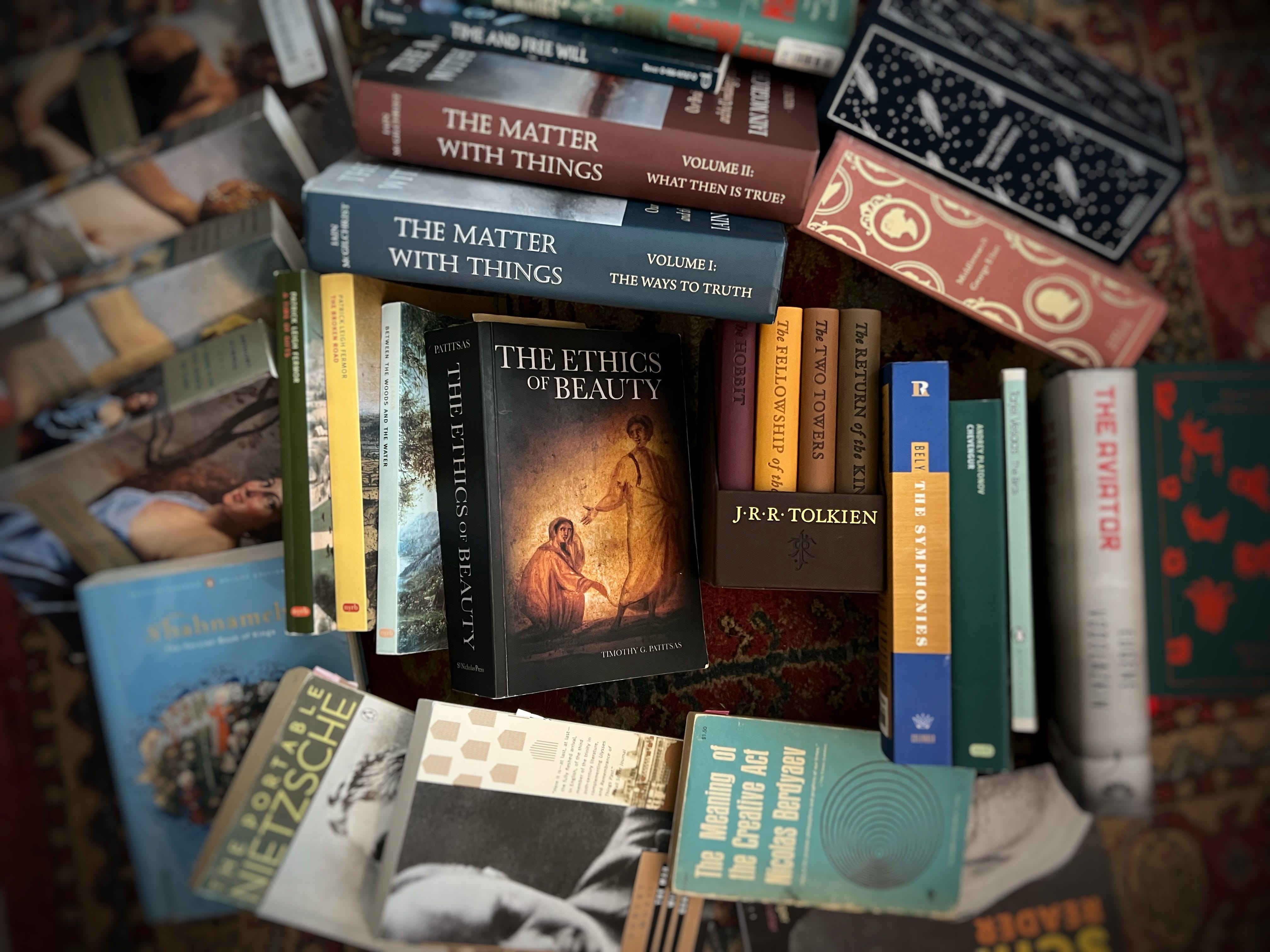
After looking back at all the books I finished in 2025, I naturally turned my eyes to what 2026 might have in store. Below you’ll find my reading wishlist for this year, containing all the books that are currently staring at me from my bookshelves. By no means is this a “reading plan,” as there’s far more than I’d be able to read in a year. Like a man going to the grocery store hungry, I ending up walking away with my cart overflowing with anything that caught my eye. Thus, I need your help trimming this list down to size. Please look it over and tell me:
Which books should I read this year? Which ones are missing? Which ones do you want to read this year?
Dostoevsky, The Brothers Karamazov and others: The snow falls heavy here in Michigan, and our Brothers Karamazov Book Club is off to a great start. Rereading the book with you, writing companion essays for you, and chatting with you all during our live discussions has given me a chance to go deeper into this book than I ever have before. If you haven’t cracked it, you still have time to get caught up and join us.
While reading the Brothers, I’ve also thought about picking up another of Dostoevsky’s bigguns—Demons, The Idiot & Crime & Punishment. Which is your (other) favorite from Dostoevsky?
Bánffy, The Transylvanian Trilogy, Volumes 2 & Volume 3: Over the past several months I’ve been savoring Bánffy’s vision of Transylvania and the Austro-Hungarian Empire as it enters its twilight. They Were Counted (Volume 1) was an absolutely beautiful read, filled with gypsy musicians, horses, and mustaches—and They Were Found Wanting (Volume 2) has not been found wanting. I thoroughly enjoy spending evenings with the Hungarian Tolstoy, and I’m looking forward to They Were Divided (Volume 3).
He’s also rekindled an interest in other Austro-Hungarian authors, such as Musil’s Man Without Qualities or von Doderer’s Demons. (I’m pretty sure I know which one Attempts to Find Robert Musil would recommend to me.)
Fermor, Travel Trilogy, A Time of Gifts, Between the Woods and the Water, The Broken Road: Traveling through Europe on foot and discovering its cultures along the way would’ve been enough. But then Paddy goes the extra mile by describing it all in some of the best prose I’ve ever seen in the English language. Reading him is like stumbling upon an old-school Anthony Bourdain.
Tolkien, Silmarillion, Hobbit & Lord of the Rings: As I distilled my Bakers Dozen Canon last year, my admiration for Tolkien and the uniqueness of his contribution only grew. I meant to read all of him again last year but somehow I never got around to it. (Glad to see the Tolkien journey Kelly | themiddlepage is undertaking.)
The Ethics of Beauty, by Timothy G. Patitsas: I took this class before it was a book. I’ll always remember the Fall of 2011, when Dr Tim assigned Christopher Alexander’s The Timeless Way of Building, and told us to read the whole thing in an evening. I’m glad to say I’ve never been the same ever since. While I’ve poked around this book for a few years, I’d like to actually read the whole thing; I’ll make a point to reach out and pester Dr Tim here on Substack as I try and finish it. Relatedly…
Christopher Alexander: I’d like to introduce more people here to Christopher Alexander’s work: Timeless Way, Pattern Language, Nature of Order, and his Turkish carpet philosophy. I built my Alexander library before several of these volumes went out of print, and I’d like to find ways to share these insights with others. I’ve never known anyone who’s read Alexander who’s life wasn’t changed by him.
Borges, Complete Fiction: Again, another book I’ve loved for years and took many things from, but there is much I’ve yet to finish. “Pierre Menard, Author of the Quixote,” “The Library of Babel,” “The Garden of Forking Paths,” “Funes the Memorious,” and “Hakim, the Masked Dyer of Merv” never get old. Yet, there’s still more I’ve yet to read.
Bergson, Time & Free Will: Bergson is one of the strongest pillars in my Shadow Canon. He wrote about all the things over which we’re currently scratching our heads: time, consciousness, matter, memory, creativity, even humor. I’d also like to pair reading him with some more from his brother-in-law’s magnum opus—Marcel Proust’s In Search of Lost Time.
George Eliot, Middlemarch: (This one’s for you, Henry Oliver.) George Eliot has certainly been having a moment here on Substack and I’d like to spend more time with her. After all, I am definitely one who cares “much to know the history of man, and how the mysterious mixture behaves under the varying experiments of Time.”
The Matter with Things by Iain McGilchrist: One book that has fundamentally changed my life is McGilchrist’s The Master and His Emissary. For the past several years, his two-volume sequel has sat on my bookshelf, threatening to collapse the whole thing under its sheer weight, so now seems as good a time to pick it up and spare myself the mess.
Goethe’s Faust: For the past year or two, my feed has been full of people invoking Faust to describe the bargain we’re currently making with technology. But few of these critics actually quoted anything from the tragedy itself. Goethe was a great mind who deserves a Renaissance. As a German-speaker, I feel I can help.
Nietzsche: Like many other philosophy students, I’ve had Kaufman’s Portable Nietzsche on my shelf for almost two decades. Like Borges, I’ve read much of it, but I’d still like to read the whole thing. Naturally, I’d pair this with some Nikos Kazantzakis.
Dickens: Bleak House, after hearing so much about it from Tyler Cowen. Or Pickwick Papers, since I’ve been on a bit of a Wodehouse kick lately and would like to read about more rowdy English social clubs.
Anthony Powell, A Dance to the Music of Time: I’ve been back and forth about reading Proust’s whole Recherche or reading this whole series. While I know I like Proust, I’ve heard Powell is also a delight. Proust or Powell, which first?
Dumas, Count of Monte Cristo: Because Lord knows I didn’t have enough big books on this list already.
Post-Humous Memoirs: Both of The Post-Humous Memoirs of Bras Cuba and A Posthumous Confession by Marcellus Emants. Proof that it’s never to late to write a good book—even if you’re dead.
Some Non-Dostoevsky Russians: War & Peace by Tolstoy; Life & Fate by Grossman; Chevengur by Platonov; Oblamov by Goncharov; The Aviator by Vodolazkin; The Symphonies by Bély (who was one of my favorite discoveries last year). Revisiting Berdyaev’s The Meaning of the Creative Act is also high on the list..
Persians: After spending a lot of time in Zoroaster’s gathas, I’ve been meaning to spend more time in Persia: Shahnameh, Rumi, al Ghazali, Hafez, etc.
Japanese: Lafcadio Hearn’s ghost stories, Kawabata, Chômei & Kendo, Junichiro Tanizaki’s In Praise of Shadow, or simply more haikus. Maybe some more Mishima.
Some Hindu-Vedic literature: Mahabharata, Ramayana, Rig Veda, Upanishads, or maybe just reread the Bhagavad Gita.
Other Shadow Canon Philosophers: Nicholas of Cusa, Jung, Huxley (mostly Doors of Perception or his Perennial Philosophy), Shelling, etc.
In any case, that’s the buffet of books laid before me. What should I sample? Which ones would you want to read? Happy New Year and Happy Reading, all! As ever, Sam.
Get caught up on my 2025 Books:


I read the shortened Ramayana by RK Narayan a few years ago, and the Upanishads in Eknath Easwaran's spiritual (rather than scholarly) edition. I've been meaning to read more of Narayan's work. He wrote several novels that look interesting.
Impressive list Sam. Oblomov is a firm favourite of mine. Nice to see it on your list!