
February 2025: Armchair Notes
A tour through history with Eugene Vodolazkin; Sheila Heti opens the door on a new world; Charles Williams tells us to "Go to Hell"; Stephen Pressfield kicks our creative butts.

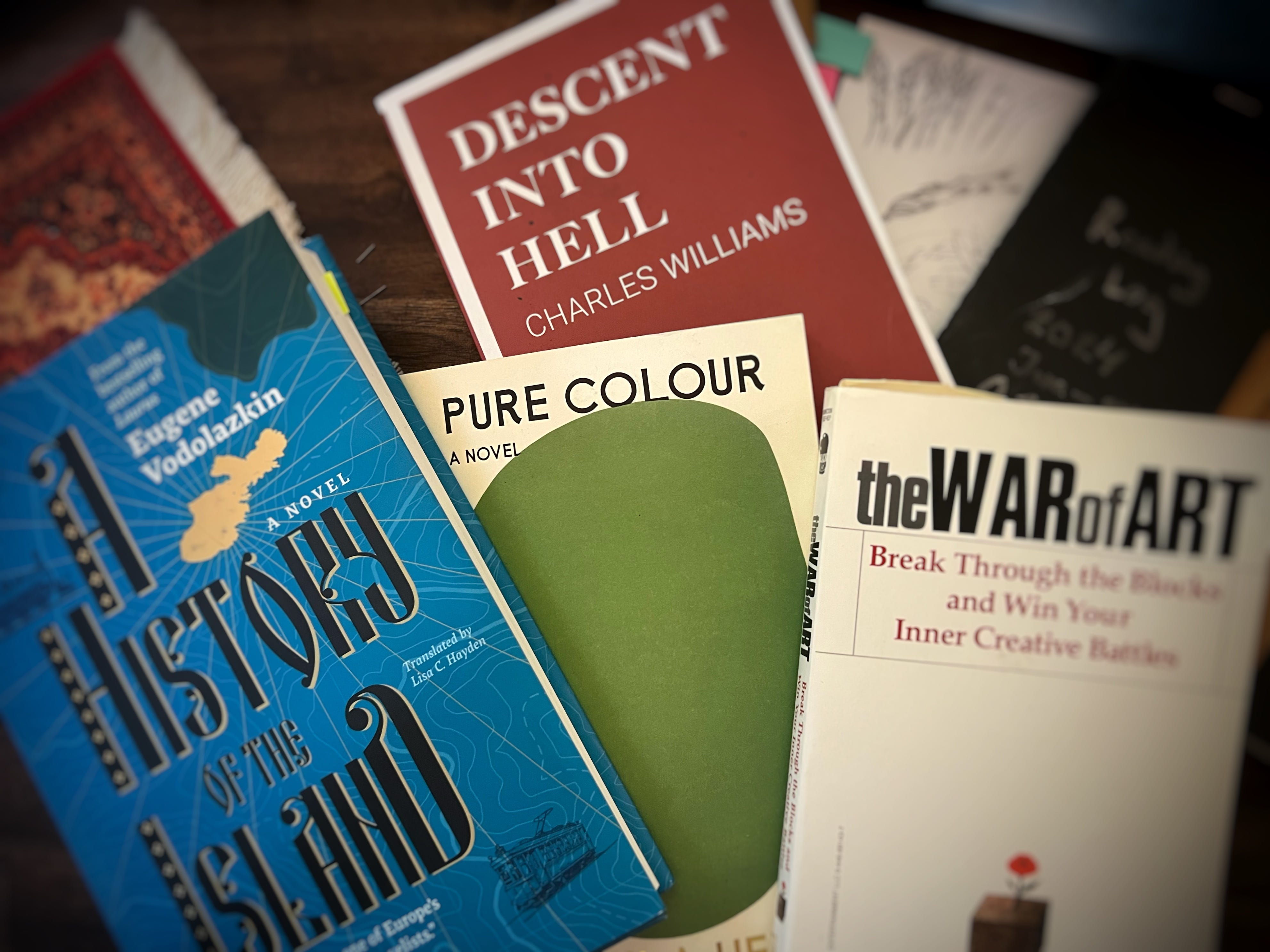
In being true to the name of this blog, here are a few notes about books I’ve finished this month. Along with a few initial impressions of my own, I’ve also included a quote to whet your appetite. In the comments below, let me know:
What you read last month? What you’re looking forward to reading this month?
A History of the Island, by Eugene Vodolazkin
Just as someone might make Dostoevsky and Tolstoy the two great pillars of the Golden Age of Russian literature, Vodolazkin and Sorokin might be the two faces of Russian fiction in our own day. Like their forebearers, I think both are ultimately committed to similar values or ideals—but each according to his own very different methods. Last month, after reading both of these authors, a trend began to emerge.
Sorokin strikes me as the enfant terrible who relishes in exposing the unsavory underbelly of Russian culture and the modern world; he specializes in satire, brutality, and revulsion, because they suit the depravity of our world. He’s like a Russian Houellebecq. In contrast, Vodolazkin has an abiding fascination with the concepts of time and history; this leads the medievalist-turned-novelist to use literature as a means to humbly and gratefully accept his place within that tradition.
In A History of the Island, Vodolazkin comes the closest to Sorokin. This novel is a chronicle and commentary outlining the history of a fictional island; the story echoes the progression of Russia (and the broader West), from its medieval origins, through phases of reason and revolution, up to the precipice of the present. Unlike Sorokin, Vodolazkin encourages the reader to reflect on our age and how we ended up here by enchantment. His two incredibly long-lived commentators, Parfeny and Ksenia, offer poignant commentary throughout the story, and act like a parenthetical pair of guardian angels, accompanying the Island on its journey through history.
While I still feel like Vodolazkin has yet to reach his apogee with his explorations of the nature of time, this expansive novel was a delight. Many have told me that his Aviator is their favorite, so maybe I’ll read that next.
Artemy asked me what, in my view, the main difference is between people in the Middle Ages and people today.
My view. People are becoming ever blurrier, and there is nothing anyone can do about that.
“Perhaps the difference is in sensing time,” I answer. “It was like slow motion then, like in an underwater filming. It flickered: now it's time, now it's eternity.”
“And how do you sense time now? As it was before or as it is currently?”
“Now? As it was before. But all the eternity has been drained out of it.”
Pure Color, by Sheila Heti
This is not a novel—this is a world. Rather than dragging you scene by scene through the protagonist’s life in a linear way, Heti offers you plenty of space to explore feelings and rediscover wonder. Each vignette in this book represents a newly discovered room in a house, a new pond to splash in, a new tree to climb. Many of those concerns that distract, numb, and busy me on a daily basis simply fell aside as I turned these pages. I realized many of these mental, social, and emotional games ceased being fun long ago. Why did I keep playing them? Like scuttling leaves, tattered clothes, or dust in the wind, these games were effortlessly carried away by this poignant little book. Then it awoke wonder. Heti does an amazing job of showing how our emotions are cosmic and the cosmos is emotional. The world is ready to collaborate with us in our play, in our art—if only we give it a moment.
“Why am I so stuck in the art of the past? Because you are stuck in this situation, thinking it is the only one. There will be a second draft, and the part of you that loves, which is the best part of you, and the most eternal part, will be in the bears, the lizards, the mammoths, and the birds, there in the second draft of life.”
Descent into Hell, by Charles Williams
Descent into Hell comes incessantly recommended by my old teacher, Peter Kreeft. He often remarks that every time he’s assigned this book, at least one student would tell him they couldn’t finish it because it was too scary. I almost didn’t finish it, but for different reasons. For me, this novel was thematically clear, stylistically stunning, but narratively confusing.
Thematically, I found it easy to identify and sympathize with William’s ideas of substitutionary love and how we can become isolated in illusions of our own projection. On the syntactic level, I constantly found gems scattered throughout the novel—Williams was prone to torrents of lyricism and it was a true pleasure to be swept away by many of his sentences.
However, I found myself lost when trying to decipher the narrative’s characters and plot. It’s often not clear which character is being referred to, nor is it clear which plane of existence he might be speaking about in a given sentence. Everything starts to blend together. And not in a good way. It took me the whole book to figure out what the narrative was.
Now that I have a sense for it as a story, I’d like to read it again sometime. But note that this book might be frustrating to new readers to Williams. Despite that, the themes and lyrical passage are worth it.
The words were no longer separated from the living stillness, they were themselves the life of the stillness, and though they sounded in it they no more broke it than the infinite particles of creation break the eternal contemplation of God in God. The stillness turned upon itsef; the justice of the stillness drew all the flames and leaves, the dead and the living, the actors and the spectators, into its power—percipient and impercipient, that was the only choice, and that was for their joy alone. She sank deeper into it.
The War of Art, by Steven Pressfield
About a decade ago, I worked with a film company on a documentary about a Christian approach culture and another one about tobacco pipes, the people who make them, and the meaning of life. During that time, I learned there are a few books that are standard issue within the film community: Robert McKee’s Story, Blake Snyder’s Save the Cat, Christopher Vogler’s The Writer’s Journey, and Julia Cameron’s The Artist’s Way—but above all The War of Art.
This is the cult classic for creatives, and it deserves all the praise it receives. A decade after my first reading, Pressfield’s creative enchiridion struck me with a fresh, new force. Many of us emerged from the pandemic hypnotized and anesthetized by our devices and countless other bad habits: doomscrolling, mindless swiping, binge-watching, chronic use of weed and alcohol, and lack of exercise. This book has gained new relevance, because Resistance has never been stronger.
The keyword for my reading this time around was Strength. Often Pressfield employs an unapologetically masculine tone. For him, soldiers, boxers, blue collar workers, and machinists will teach you more about creativity than an MFA ever could. (I believe Matthew B. Crawford would concur.) Stoicism and endurance carry us through our creative work more than occasional inspiration or flimsy insights; our strength comes from somewhere else than pure grit. In this sense, Pressfield speaks about the nous vs the psyche (see my review of the Eternal Tao for more on that). Creativity comes from an abiding and eternal source beyond the passing adversities we think of as life.
Remember, the part of us that we imagine needs healing is not the part we create from; that part is far deeper and stronger. The part we created from can’t be touched by anything our parents did, or society did. That part is unsullied, uncorrupted; soundproof, waterproof, and bulletproof. In fact, the more troubles we’e got, the better and richer that part becomes.
Or if you liked this post, feel free support my work just this once and Buy Me a Coffee ☕