
April 2026 Armchair Notes
Review of Eugene Vodolazkin's Aviator

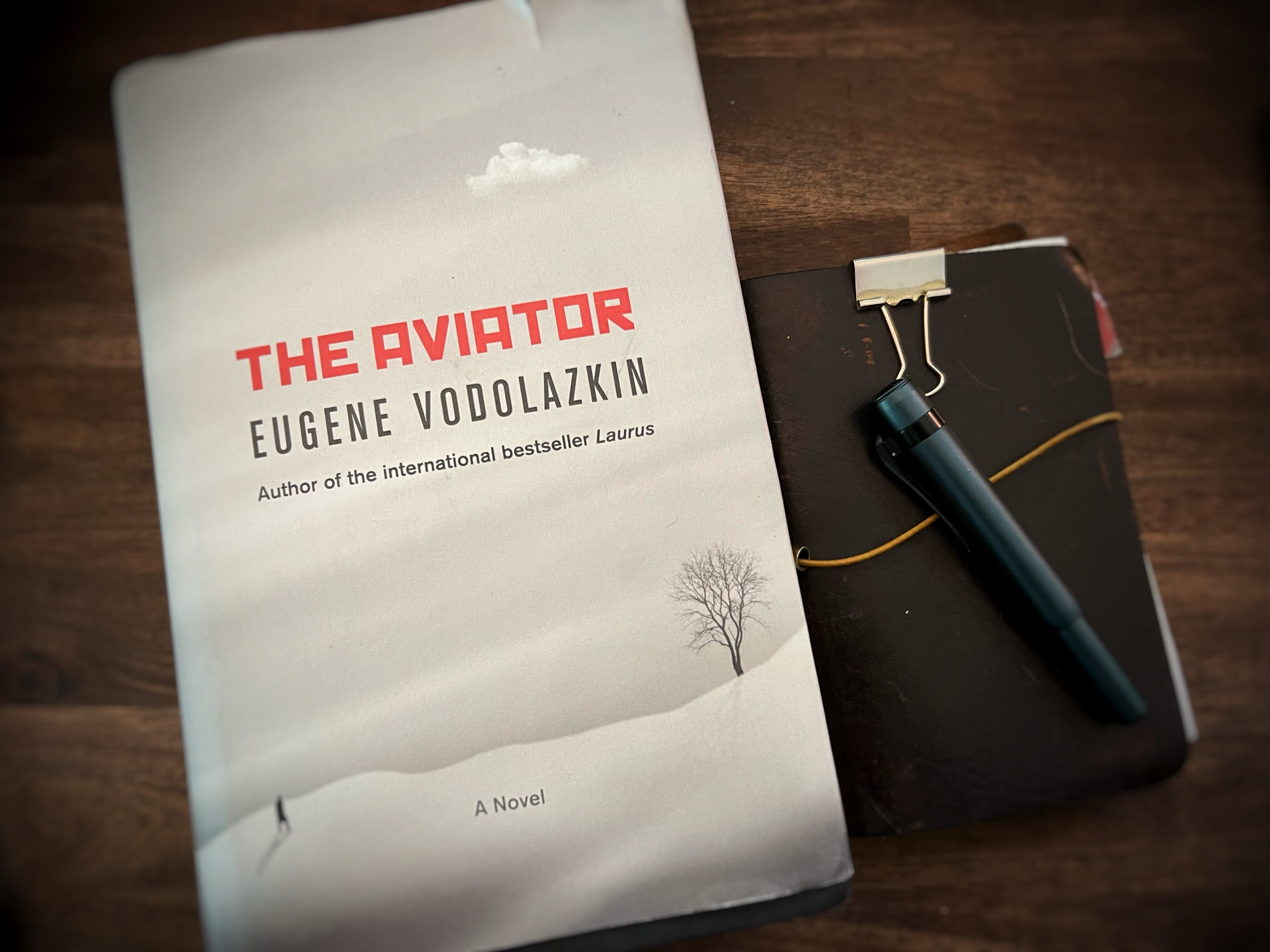
Since I’ve been so focused on writing the final Brothers Karamazov essays as of late, I’ve not had all that much time to read anything outside of rereading Dostoevsky. But I did find the time to read one book during April. So here is my extended review of Eugene Vodolazkin’s The Aviator.
The Aviator, by Eugene Vodolazkin
Eugene Vodolazkin’s Laurus came out in English translation a little over a decade ago. The novel was well-received in Christian literary circles, and it even became something of a cult classic among Eastern Orthodox readers. This dreamy voyage into the mind of a Russian holy fool made an impression on me back in the day, and I was glad to see it still resonate with me when I revisited it last January. Whenever I brought up Laurus with lovers of Vodolazkin, they would inevitably tell me I “had to read” his subsequent novel, The Aviator. Their devotion to this modern Russian deep cut always struck me as a bit mysterious, as they wouldn’t tell me much about the novel—aside from “it has something to do with time.”
Nevertheless, I’ve checked back in with several of these readers and their admiration for the novel continues to radiate. So I thought I’d crack it open before the weather got too pleasant to read Russian novels anymore. (The cover has a man wandering in a barren landscape, covered in snow, for crying out loud.) Coincidentally, it turned out this was the perfect time for me to read The Aviator.
The premise of the novel is that our protagonist wakes up in a hospital bed, not knowing who he is or how he got there. Gradually memories return to him, new information is given, and we learn he was part of a government project which preserved his body in order to resuscitate him in the future. Along with millions of other moviegoers, I also saw the recent release of Project Hail Mary last month—around the same time I read this novel. This coincidence gave me a chance to compare notes between these two stories; both begin with a hero waking up, ignorant to who he is and why he finds himself in this position. While almost all heroes are ignorant of who they will become at the story’s end, it’s unique to come across a hero who doesn’t know who he was before the story even began.
Since Vodolazkin tells the story through our protagonist’s journal entries, we learn about Innokenty as he learns about himself. Admittedly, this narrative format made for a slow burn during the first half of the book. But that could have been my fault. In another coincidence, I read Bernanos’ stunning Diary of a Country Priest last month (reviewed here), and it obviously employed diaristic narration as well. With my personal journalling habits added to these two books, maybe I simply exceed my quota for fragmentary recollections.
But then the second half began incorporating entries from two other voices, and the plot quickened. Rather than living inside the mind of one person trying to remember who he was, the story became a fugue of perspectives as three people attempted to navigate this new world and the relationships they created. In characteristic Vodolazkin fashion, the syntactic boundaries between their entries began to blur, and their voices harmonized into a satisfying style of polyphonic narration.
After this novel, Vodolazkin went on to employ this approach to great effect in his fantastical-historical chronicle A History of the Island (reviewed here). In this way, I found The Aviator to be an inflection point between the personal ruminations of Laurus and the historical reflections of The Island, both exploring the expressive potential of a common style. Innokenty is only one man whose life spans so many major (and tragic) shifts in the modern world: he mourns a past he has lost, he finds himself disoriented by a present he doesn’t understand, and we wonder what the future might hold both for him and the world itself.
Overall, I found it a sympathetic novel that raised questions about time, memory, and history. It’s hard to read about a character being thrust into a time so similar to your own and not wonder about what role you might also play in it. Additionally, its style made me wonder what role my own journal entries might play in holding the world together, if only in my memory. Here are some quotes from several of Innokenty’s entries to give you a taste for this thoughtful novel:
Because of my father, I thought about the nature of historical calamities—revolutions, wars, and the like. Their primary horror is not in the shoot. And not even in the famine. It is that the basest of human fervors are liberated. What is in a person that was previously suppressed by laws comes into the open. Because for many people only external laws exist. And they have no internal laws.
I turned on the landing and cast a glance at the lighted triangle of the door. Behind the escort guard’s backs I saw my loved ones for what turned out to be the last time. Even now I see them with photographic precision. I know they saw me the same way when I turned. They photographed me for a lifetime: the flash of their grief illuminated me. The two photographs will merge into one after my death.
Paradise is the absence of time. If time stops, there will be no more events. Nonevents will remain. The pine trees will remain, brown and gnarled below, smooth and amber at the top. The gooseberries by the fence will not go anywhere, either. The squeak of the gate, a child’s muffled crying at the next dacha, the first pounding of rain on the veranda roof… all the things that changes in government and the falls of empires do not wipe out. Whatever happens outside history is timeless, liberated.
Of course the sound of the forest and the sawing of ferns and the smell of the pine cones and the sky also existed on the island… Things of this sort gave birth not so much to hope as to a change of fate (it was not foreseen), and they seemed to attest that elements of the rational still exist on earth, in nature if not in people. Here there is also the creak of a door in the wind (a listless sort of creak but then a sudden energetic slamming) and the smell of the fire at the logging site. You looked at the fire for a minute, toss in a piece of kindling or two, and that seems to ease things. It burns as it should. Human laws can be revoked but it turns out the physical ones cannot.
The conditions were terrible on this absolutely bare island, where the wind blew eternally, and many did not survive. I write that and now shadows that were once people wander along what I wrote. The words crumble into dust: they do not come together into people at all.
In general, I think that when you describe a person in a genuine way, you cannot help but love him. Even the very worst person becomes your composition: you accept him into yourself and begin feeling responsibility for him and his sins—yes, for his sins in some sense, too. You attempt to understand and justify all of that, so far as it is possible to do so.1
Thanks for reading. Feel free to get caught up on other books I have read or the other books we’re reading together through the links below. As ever, Sam


Clearly, Vodolazkin has read his Elder Zosima.
Ok fine… I’ll add it to the pile. Another strong recommendation and that’s why this is my favorite post of the month here on Substack. Coincidentally, I’m halfway through Your Absence Is Darkness by Jón Kalman Stefánsson (really really good so far) and it begins exactly like this one.