
On Pets, Personhood, and Playing God
Thoughts on the Death of My Cat

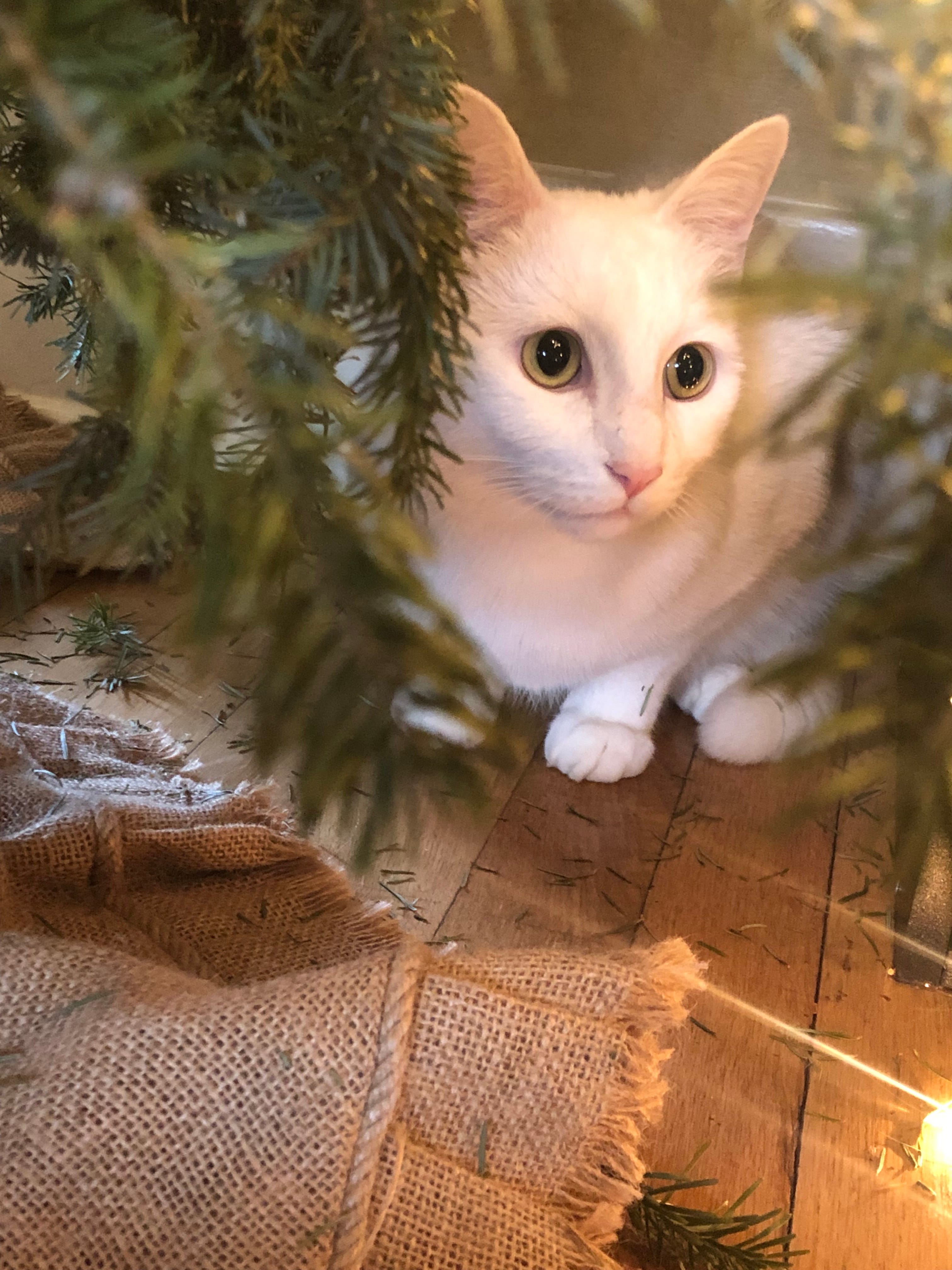
Over the past few weeks it became clear that my cat was nearing the end of his days with our family. While he had always been slender, now he was gaunt. His snowy white coat began to sink into hollow spaces just before his hips. Where once his ears, nose and lips had a pleasant pink undertone, now his flesh took on a jaundiced hue. Each vertebrae along his spine became more pronounced, and my fingers felt like a wooden mallet running across the rippled back of guiro whenever I petted him. His shoulder blades and collarbones protruded as the soft fat and muscle which once held him together began to vanish. All of these changes came within days of each other.
Before then, we had noticed he wasn’t emptying his food or water bowls. We swapped out a few different brands of food over the past month, but nothing worked. One evening we had a minor victory with some shrimp. But more often, he would barely sniff the bowl before springing up the stairs and pawing at the back door to be let out.
At the first sight of spring, he was always known to jet outside and spend almost of his time under an open sky—rolling in dirt, sunbathing on the sidewalk, lounging on our neighbors’ porch, nestling into a garden bed, hiding in a hedge of arbor vitae. We assumed he had learned the ways of the other neighbor cats and preferred earning his meat through hunting birds and mice rather than accepting our meager offering of dry kibble. Also, when he did come inside, his preferred drink of water always came from a freshly flushed toilet or the dripping faucet after a shower. Between his outdoor frolicking and sneaking sips from the bathroom, we assumed he was moving into an era of newfound self-sufficiency. But the opposite proved to be the case.
*
By the time his body had shown its symptoms, it was already too late. Liver or kidney failure. I had seen the same markers of decline in my childhood cat. However, her decline was more gradual than his. She lost her spry agility over the course of a year or more, becoming a frail yet dignified lady.
One day my mom called me to let me know Marmi’s health had taken a turn. That night my brother and I—now two grown men in the mid-twenties—sat on the floor and petted our cat, just as we had done as kids. She couldn’t move much and her bowels were prone to accidents, so we wrapped her in a towel on the kitchen floor, near her food and water (both untouched), before heading to bed. But I couldn’t leave her there. On the cold stone, I laid out a blanket and a pillow for myself to keep vigil with my poor cat, reassuring her with gentle strokes of my hand that she wasn’t alone. My hand was on her when I felt her last breath leave her—and suddenly I was alone.
*
One cold night in January, years ago, my roommates and I were outside having a smoke on the porch when a small, snowy cat came up and began nuzzling our legs. We opened the door and he let himself in. Then we sat around the absinthe fountain, while our new friend began nimbly climbing over all of us, wrapping himself around our shoulders like a scarf, sitting in our laps like a muff. Naturally, we had no cat food in the house, but we cooked up some shrimp and his attention became piercing upon catching a whiff. After devouring a handful of shrimp, he retired to the red rug under the table and simply stretched his paws and claws in the warm and friendly air. That evening we watched an episode of The Mandalorian. Looking at the big eyes and pointy ears of this adorable foundling, we joked that we should name him “Grogu.” That joke eventually became his name.
For a short time, we thought his name would be “Ollie.” One of my roommates decided to give this stray a bath. For some reason (ChatGPT didn’t exist yet, so this hallucination must have been his own), he decided to “condition” the cat’s coat with olive oil. The greasy feline slinked out of the bathroom looking more mangy than he walked in. Olive oil… Oliver… Ollie... Still it never really caught on—it was no match for the delightful absurdity of “Grogu.”
*
Grogu was a handsome and even enviable cat. There is something classy and even deliciously sinister about sitting in a lounge chair with a perfectly white cat on your lap. He made you feel like a Bond villain. We all loved having him purr on our laps while we plotted world domination. But soon after welcoming him into the house, the question of ownership turned into a point of debate among us villains.
Since this was my house—and my furniture would likely be subjected to some scratching and spraying—I assumed ownership defaulted to me. While I grew up with cats, I had still never truly “owned” one, so I was open to advice. The “olive oil conditioner” roommate mentioned that his friend’s fiancée was a vet, and he could take him in for the normal onboarding stuff of checkups, chipping, snipping, and shots. “Great just give me the bill and I’ll reimburse you,” I said.
When they returned from the vet, he didn’t have a copy of the bill. Weeks went on and he still was reticent to supply a receipt whenever I asked. Gradually, it became clear that a competition for Grogu’s affection had begun: Would he sleep in my room or the other roommate’s? Tensions rose. He claimed it was his cat: he put in the effort to find a vet, he took him in for visits, he paid for them. At one point, (memory is fuzzy) I think he mentioned something about Grogu being his “birthday present” or “my precious.” I told him I had the money in my “pocketses,” but the conversation seemed destined for futility, so I left for work.
When I returned, my cat and my roommate were gone. He had whisked my cat over to his girlfriend’s apartment, and left the rest of his belongings behind. After a couple days, my messages got through and Grogu was dropped back off. But it took much longer for the roommate to return. During that period of absence, any claim of ownership was surrendered, and he became officially my cat.
When the roommate returned, he and I cheersed a couple pints and laughed at that silly patch in our history. But the moral of the story is: If you would’ve met Grogu, you would’ve been mesmerized by him; his green eyes would make you jealous for him; you too would become possessed by a desire to have him all to yourself.
*
There are certain clear cultural boundaries in this world. Cultures who cook with butter and those with oil. Cultures who drink beer and those who drink wine. Cultures who like dogs and cultures who like cats.
One winter day I sold a bronze Turkish tea pot set online, and an old Turkish man came to pick it up. He was bundled up from the cold and stood on my (Anatolian) rug by the door. At the sight of my spotless white cat, the Old Turk’s mediterranean face lit up and he exclaimed, “My my, what a beautiful coat you have. You must be licking yourself all day to stay so clean!”
*
Cats are stoic and subtle creatures. Dogs telegraph every emotion by eye, mouth, and tail; whimpering, barking, and panting are daily occurrences with them. But cats largely spend their time in solitude, sitting alone with their thoughts or slinking off to explore the neighborhood on their own. You know almost everything about a dog, and almost nothing about a cat. Only a sphinx could be sphinxlike. Anubis had no secrets.
One day Grogu came back to the house after one of his adventures, and we were shocked by his leg. Somehow a patch of fur and skin has been torn clean off of his hind leg. It looked like someone took the skin off a chicken drumstick. No blood, just pink meat and ligaments. If you did that to me, the whole town would’ve heard me wail. Nevertheless, we could never guess by his face whether he was in pain. We got him sewn back together and he healed up just fine, but he never acted as though anything was bothering him. Throughout it all, Grogu exhibited a dispassionate serenity which would make Cato jealous.
*
Losing an animal is tough enough, but being a good parent adds another challenge. Just a few months ago, Hans was still mispronouncing his name “Grolu,” but in the past couple weeks he had begun calling him “my cat” and „meine Katze.”1 How should I tell my son what was going to happen to our cat? To his Katze?
“How are things coming with the Dostoevsky books I lent you?” My priest just happened to call the same day I took Grogu in for a final consultation with the vet. I looked at the Karamazov companion essay for Book Nine, marked up in red pencil, on the sideboard along with Fr’s copies of Joseph Frank’s biographies and lectures on Dostoevsky. My writing has been unfortunately eclipsed by Grogu’s recent decline. “Good, I’m almost done with them,” I lied. “But since I have you on the phone, do you mind if I ask you a pastoral question, Fr?”
While I didn’t want to neglect my parental duty to talk to my son about death, I also didn’t want to force issues on him he wasn’t thinking about—or issues I couldn’t even articulate myself. I imagined telling him “He’s going to be with Jesus” and almost gagged on the kitsch of it.
“You don’t have to explain anything he isn’t wondering about. Just let him ask the questions,” my priest counseled, “and maybe read some of Romans 8. It might help him and might help you.”
*
For I consider that the sufferings of this present time are not worthy to be compared with the glory which will be revealed toward us. As it is, the creation waits with eager expectation for the revelation of God’s children. Indeed, creation was subjected to futility, not of its own will, but because of him who subjected it, in hope that the creation will also be delivered from the bondage of decay into the glorious freedom of the children of God. We know that the totality of creation groans and labors in pain until now.
— Romans 8:18-22
*
Shortly after that phone call, I picked up a frail Grogu and sat on the steps of our front porch. The recent rain had softened the ground and my son was absorbed in dragging the tines of a hand rake through the dark, wet earth. „Hansi, kannst du hier kommen?” I asked. ,,Nein,” he replied, continuing to play in the dirt by our front steps. I paused to think of a new tactic. “Grogu is going somewhere else and we want to talk to you about it,” my wife interjected with her refreshing directness.
Hans set down his gardening tools and slowly stood up with an air of gravitas. With his hands held in small fists by his side and his shoulders broad, he walked over to us, gave daddy his full attention and asked, “Why?” ,,Grogu ist sehr krank und sehr müde—Grogu is very sick and very tired,” I said, “His body isn’t working well anymore. He’s too sick to live with us in our house, so he has to go somewhere else.” My boy looked at his cat, thoughtfully. I continued, “So tonight is our last night with him.” “Then he goes bye-bye?” “Yes, then he goes bye-bye.” He petted his cat and then went back to playing in the soft, dark earth.
*
Our metaphors for the body and soul are so misleading. My soul is not a bird trapped in a cage, nor is my soul a ghost in the machine. While the body clearly has its limitations, those are not the same limits of the soul. If anything, I think the analogies should be reversed: the body is held within the soul.
I like to think of it like this: The body is like a clump of dirt or a handful of pretty pebbles; our soul is the hand which picks up this material and carries it around for awhile. No matter how beautiful or interesting this handful might be, there comes a time when we need to unclench our hands and set it down somewhere. Maybe we stretch out our fingers and rest our palms in our lap. Maybe we reach our hand out the car window and let them surf on the wind for a bit. Maybe we set this handful down only to pick up something else, somewhere else.
*
One night I found myself musing about future trips with my wife. We have a long vacation coming up and, since I work remote, we’ve also toyed with the idea of living and working abroad for a season. In both cases, the same question always arises: Who will take care of the cat while we’re gone? This evening, I found myself teetering on the edge of a bargain. “If I get rid of the cat, can we go be ex-pats for a couple months?” This comment was only a week or so before Grogu’s decline began. Now I wonder whether he heard me.
*
Forgive the heresy of a grieving man—but it’s undeniable to me that animals have souls. We call them animals because they are animated by an anima. There is some kind of hand that hold their dirt together, and that hand must go somewhere after setting the body aside—just as with us. They are centers of perception, reflection, passions, and agency. While they don’t seem to ruminate on the past, agonize over the future, or try and figure out the present moment as we do, the term “animal psychology” nevertheless is not an oxymoron. I feel the difference between us and them is largely one of degree rather than kind. We might be rational animals, but we spend much more of our time being animals than being rational.
Nevertheless, perhaps there’s a difference between having a soul and being a person. In Genesis, we read that humanity is the only animal that was made “in the image of God” (1:27). This Image is a great mystery, but all agree it has something to do with personhood—and personhood seems to be something held in common by humanity and divinity alone. Meanwhile, the stars and sea, the fruit trees and stones, the living breathing animals apparently get along fine without it. However animated an animal might be, it seems they do not have this image or personhood, by nature.
But part of me wonders if the same could be said about humans. After all, I was not a person until God made me into one. Just as Adam was just once a clump of dirt, I was a clump of cells before God—out of the fullness of His personhood—extended a share of personhood to me. From that moment, we all hold this interpersonal quality in common. He calls us into being and He calls us by name. Through giving us a name to be called by, He no longer speaks about us but speaks with us.
Then, as the story goes, he gave us the task of naming all the animals. Why? So we could talk to each other about them? If we are to follow the pattern He set, I assume our job is not only describe animals but to address them, personally. We give them names in order to speak with them. Having “dominion” over animals seems like an impressive word for the tamer concept of “domestication,” and what is domestication but continuing the work of personification which God began in us?
Pets give us a chance to play god. Their clay is molded into the owner’s image. The question is: what kind of god will we choose to be? The gods in many of our myths are anthropomorphized projections of our own pettiness, magnified by illusions of power. Many of us have acted like heathen gods to animals: beating them into submission, confining their movements, and processing them for our own ends. These animals are more products than persons. On the other hand, there are other ways to relate to animals which are truer to divinity. House pets are (again depending on the owner) more saintly than their wild counterparts; they have been delivered from the danger and necessity of the wild world into the gracious world of the home (domus). Through regular meals, affection, and companionship they share in the personhood of their owners. We begin to know each other. They come when called by name.
Then again, not all animals are pets—we eat some of them. To put it mildly, eating someone’s flesh seems like a rather impersonal affair. How can you personify something you’re going to put on a plate? Maybe personification becomes easier when you quit looking at animals as source of meat, cheese, or eggs. But maybe the hunter and the farmer have a respect and love of animals that is no less noble. The hunter who shoots a deer with a bullet spares him the tooth and claw or the wolf. The good farmer who ends a life full of grazing with a quick death took better care of the cow than letting her fend for herself, leaving her to wither into a frail decline.
If we talk to our gods at all, we tend to pray that they be merciful to us when it comes to our deaths. More even than a good life, a good god gives a good death—and that is what domesticated animals ask of us.
*
That final day I awoke wondering what kind of god I’d be to my cat. I opened the bedroom door and saw him welded to the same spot on the hallway runner where I sat him last night and opened my son’s door. ,,Guten Morgen, Grogu!” He petted his Katze and we moved on to breakfast. Before leaving the house I reminded him this was his last chance to say goodbye to Grogu. He stroked his white fur a few times, and waving his hand said, ,,Tschüß!”
When I came back, he had not moved from his spot on the runner. I picked him up and we reclined in the living room one last time. For once I wasn’t holding a book he had to nudge out of my hand. His purring seemed larger than what his fragile body could hold. The day was bright, with a gentle breeze, so I got up from the chair and opened the door for him. He clambered down the front steps, and began digging in the soft, dark earth. He used the bathroom one last time and cleaned up after himself, dragging heaps of dirt over the puddle he made. (What a conscientious lad.) Then he flung himself on the warm sidewalk and rolled around a bit, before slinking off to the backyard—sniffing at the wind, nuzzling dandelions, and eventually settling under our hedge of arbor vitae. He slowly blinked and soaked in a jubilant chorus of birds carried upon the breeze. He was a brilliant white spot standing brightly against the green trees and dark mulch.
*
We arrived at the vet and I let him crawl around the grass outside the office. He didn’t seem to mind the drive in the carrier, but still I figured he’d appreciate as much fresh air and fresh earth as I could spare before our appointment.
We entered a room with a soft, grey blanket on a table and generous bench in the corner. Gentle piano music was playing, and there was a jar of chocolate kisses next to the sink. Apparently, it’s customary to let dogs get a chance to enjoy some chocolate before passing on. Grogu wasn’t interested, but I certainly availed myself of this unexpected bit of Kummerspek. The whole process happens in a few phases, with doctors and your pet coming and going, so a couple chocolate kisses help fill and sweeten those otherwise bitter pauses.
They leave you a little doorbell buzz, so you can ring when you and your pet are ready for the doctor to come back in. Fittingly, our vet was the fiancée my former roommate knew: she got to meet Grogu when we welcomed him into the house and she helped us send him on his way. After welcoming us, she left and I laid back on the bench with my cat—with my old friend—on my lap for one last time.
Under the fluorescent light of a medical office, his fur became dazzling white, whiter than launderer could bleach it (Mk 9:3)—and soft as ever was it to the touch. While petting him, I could feel the flame of life had turned down to a flicker; his purring and heartbeat felt smaller than before; the jaundice flesh around his lips and eyes looked like he had been smeared with olive oil. Still it was good to be together. I wept. Then I rang the doorbell.
Dr Catie and I wrapped him up in the soft, grey blanket. She then took him to another room where a vet tech could place the catheter in his foreleg for the injections. After a few minutes, they returned and set a large bundle of soft, grey blanket in my lap, with a white foreleg and white face sticking out of it. I became one large hand, holding this precious clump of cat. His face seemed tired but a bit relieved. (Again the stoicism makes it hard to say.) I watched the sedative move through the tube of the catheter into his arm. Aside from one slow blink, his face seemed unchanged. After a minute or two, she fed the final injection through the tube and I watched it reach his foreleg—and suddenly I was alone.
*
Back at home I buried him next to our hedge of arbor vitae. His favorite resting place became his final resting place. I dug a hole in the soft, dark earth. I coiled his snowy white body and pet his soft fur one last time. I opened up to Romans 8 and read some verses about creation groaning. Then I tucked him in.
*
Walking through my empty house, I saw crawl marks in the leather ottoman he always sat on. I picked up the saucers and water bowls I scattered through the house in these final days. I thought of who might want the leftover bags of litter and kibble in the basement. A patch of white fur clung to the hallway runner. Even after several days, my eyes still expect to see him lounging in his familiar place—and maybe somehow he is.
As for me, I don’t know how to describe what it feels like after fulfilling the duties of ownership. I’m glad my friend is no longer suffering but I’m sorry he’s no longer here. (Χαρμολύπη—“joysorrow”—is probably the word.) He was a good cat. I wonder whether I was a good owner. We men do not make very good gods, but still we try.
Again, the stoicism makes it hard to say for sure. But Grogu apparently did not mind being called ,,eine Katze” rather than ,,ein Kater.” After all, Kater means more than just “male cat.” Maybe he thought it would be ridiculous to see a toddler running around, talking about how much he loves petting his “hangover.”
This was truly beautiful, what a tribute to a beautiful friend. I am a veterinarian, and I walk this road daily, often multiple times a day with hurting people who want answers. I’d like to leave you with what I tell my sweet people: all of creation declares His glory, and in our pets, often that unconditional love can be felt more tangibly through their lifetimes than in the sunrise or the flowers. He loves us, He loves them and Christ redeems all of creation.
Here is the prayer I send in my sympathy cards. I pray it puts gentle salve on this wound:
Author of Creation, we pause to say “thank you” for your good creatures.
Here was your good creature, O Lord, called to life through your voice and by your own compassionate design.
We thank you for this loved creature, the spaces and the days we shared, enjoying the glad company and the cheerful companionship of this beloved pet.
We made room in our lives
room in our homes
room in our hearts.
We thank you for the right and fond affection for another living thing your hands had made, delighting daily in it’s presence.
Now this season for our shared lives is ended by death. Our hearts are unprepared for this loss and we grieve deeply.
Even so, Lord, we are grateful for the life that was, for the gift of a living thing so easily loved.
We are thankful for the many blessings of knowing this creature and for the lingering imprint of such a cherished presence in our lives. We are grateful for the good memories of sweeter times.
We are grateful, O God for the happiness that was,
even as we mourn the sorrow that is.
Even as we sit in the sorrow of now empty spaces, in our hearts and in our homes...empty spaces that echo our loss.
Now we say our goodbyes.
We know if no sparrow falls beyond the reach of your knowledge, that you also, in this moment, see our sadness at this wounding, your weeping at the world’s brokenness somehow deeper than our own.
Be near us, O God. Be near each of us who must reckon with the sorrow of death and the sting of separation, for what we feel in this loss is due to the brokenness of your creation, and we long for the day of your eternal kingdom and the redemption of all creation.
You are a God who defeated death, who saves from the very pathway to hell. Even in our sorrow we praise you and we long for the sweetness of your eternal victory.
Be with us, O God, in sadness,
in grief
in pain
in simple memories
in healing joy of redemption.
Adapted from Every Moment Holy- by Dr Kaki Nicotre
Beautifully written, it really hit home. It’s clear that you were a wonderful owner.