
Great Nietzsche Pairings
What books and movies go well with Nietzsche's Zarathustra?

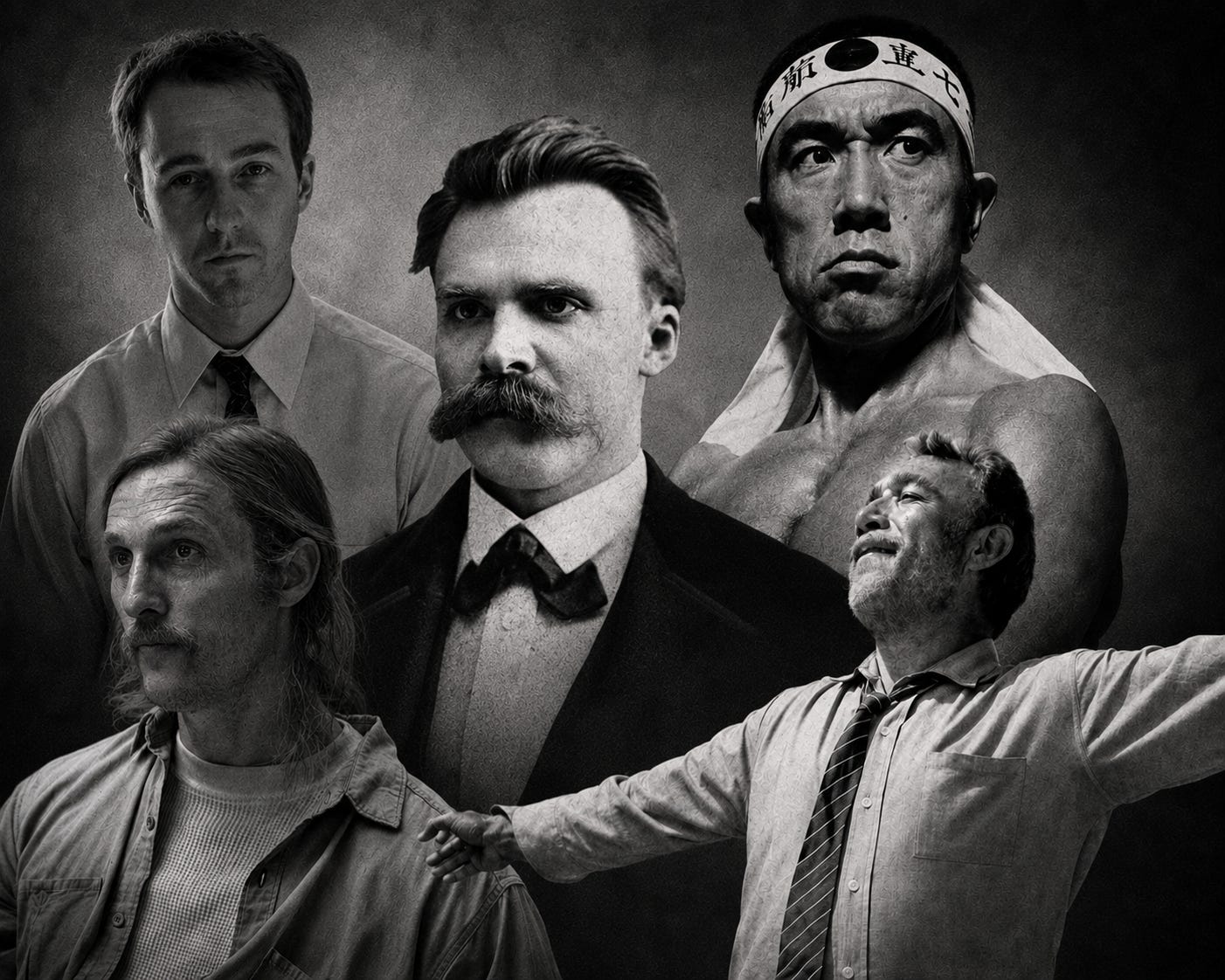
This May and June we’re kicking off the summer by reading Nietzsche’s aphoristic classic Thus Spake Zarathustra. Since this book isn’t as long as the Russian novels we’ve been covering so far in the year, you might want to take advantage of the extra breathing room and dip your toes into some other authors who explore similar themes to Nietzsche’s fictional prophet.
Here are a handful of recommendations I think pair well with Nietzsche.
A Double-Shot of Nietzsche
The Portable Nietzsche, edited by Walter Kaufmann: Naturally, the easiest pairing with Nietzsche is more Nietzsche. If you’re reading Thus Spake Zarathustra out of this portable collection from Walter Kaufmann, you also have the unabridged texts of Twilight of the Idols, The Antichrist, and Nietzsche Contra Wagner included. In addition to these major works, there are also crucial selections from The Gay Science, Genealogy of Morals, Birth of Tragedy, and many letters. If you read this one volume cover-to-cover, you can certainly tell people, “Yes, I have read Nietzsche.”
Explore the Original
Gathas of Zoroaster: Nietzsche borrowed his prophet’s name from one of history’s most influential teachers. The ancient Iranian prophet Zarathustra (7th century B.C.), whom the Greeks called Zoroaster, preached an ethical monotheism that survives to this day. In Zoroastrianism, believers struggle between the cosmic forces of light and darkness, truth and lies, the path of Ahura Mazda (“Lord of Wisdom”) and the path of his rival deity Angra Mainyu (commonly known as “Ahriman” in his Middle Persian name). The faithful can move the world out of the darkness and into the light through having “good thoughts, good words, and good deed.” Zarathustra’s Gathas share a surprising moral and literary kinship with Old Testament’s Wisdom Literature, Christ’s parables, and passages of the Quran. There was a revival of interest in Zoroastrian concepts among philosophers in the 19th-20th centuries (when Nietzsche wrote his Zarathustra), but these Avestan Scriptures are still incredibly under-read in our own time. So now is a great time to ask the question: does Nietzsche’s Zarathustra affirm, subvert, or invert the original?
Literary Counterpoints
Zorba the Greek, by Nikos Kazantzakis: Zorba embodies an utter affirmation of life—with all its passions, chaos, and contradictions. The narrator of the story has lived most of his life with his nose in a book until Alexis Zorba shows up, grabs him by the lapels, and shakes him into a world of dancing, wine, romance, and zithers. Just imagine you ran into Nietzsche’s Zarathustra while on holiday in the Greek Islands.
The Sun & The Steel, by Yukio Mishima: Nietzsche urged people to recreate their values and their lives—and Mishima answered the call. Being dissatisfied with the weakness and ugliness of the modern world, he became obsessed with the cultivation of strength and how to live a beautiful life. Tragically, he also become obsessed with how one can die a beautiful death. In all of Mishima’s works, one finds a powerful vitalism and eloquent prose, both of which would make Nietzsche proud. (See my review here.)
Fight Club, by Chuck Palaniuk: In this cult classic, Palaniuk’s narrator and Tyler Durden wrestle with creating one’s identity, the destruction of inherited values, and what it means to build something new out of nothing. Nietzsche’s will to power, the transvaluation of values, and angsty nihilism are all on display in this brutal meditation on becoming oneself in the modern world.
Dostoevsky’s Notes from Underground, Crime and Punishment, Demons, or The Brothers Karamazov: The underground man exhibits a dissatisfaction with life as it is. Raskolnikov transgresses established moral frameworks, but is still haunted by his conscience. Demons wrestles with the question whether social rebellion arises from creative urges or demonic possession. Finally, The Brothers Karamazov explores the nature of human freedom itself and how we might take responsibility for each other. (Follow my companion essays here.)
The Prophet, by Khalil Gibran: If you enjoy Nietzsche’s collection of lyrical aphorisms and poetic meditations on freedom, love, and self-overcoming—but you could use a bit less nihilism—you might pick up Gibran’s classic. Given how popular and widely translated this collection of poetry is, a case could be made that Gibran’s prophet is more influential than Nietzsche’s.
Non-Book Pairings
Groundhog’s Day: Nietzsche’s concept of Eternal Recurrence asks a simple question: What if you had to live this same life infinitely, over and over again? This concept is more familiar to cyclical religions like Hinduism and Buddhism than it is to the West’s more linear approach. But in this film, Bill Murray’s Phil Connors is forced to live one normal day over and over again, and he must ask: Is it worth affirming eternally? The 2020 film Palm Springs approaches the same question, but this time traps two people in a time loop together. By watching this pair live out the same day over and over, couples might ask how their own love might find meaning in the infinite repetition of showing up for each other everyday.
True Detective, Season One: Matthew McConaughey’s Rustin Cohle is an absolutely Nietzschean character. But this puts Rust in an awkward position: Personally, he’s a nihilist whose world has no ultimate meaning, but professionally he’s a detective who holds depraved criminals accountable for the evil they do in the world. How will Rust’s philosophical ideals survive their confrontation with his real life? Is consciousness really “a tragic misstep in our species’ evolution”? Is “time a flat circle”? This series puts many of Nietzsche’s most powerful ideas to the test.
Also Sprach Zarathustra, by Richard Strauss: This famous symphonic piece has the same name as the book. Need I say more? If Strauss isn’t exactly your cup of tea, feel free to listen to some Wagner and you might hear what Nietzsche loved (and hated) about him.
Let me know: What other books, movies, or music do you think pairs well with Nietzsche?
Learn more about books I’m reading this year:


Nic Pizzolatto at the True Detective Season 1 10 year anniversary: "Neitszche could be answered by a freshman philosophy student."
Direct quote.